Executive Summary
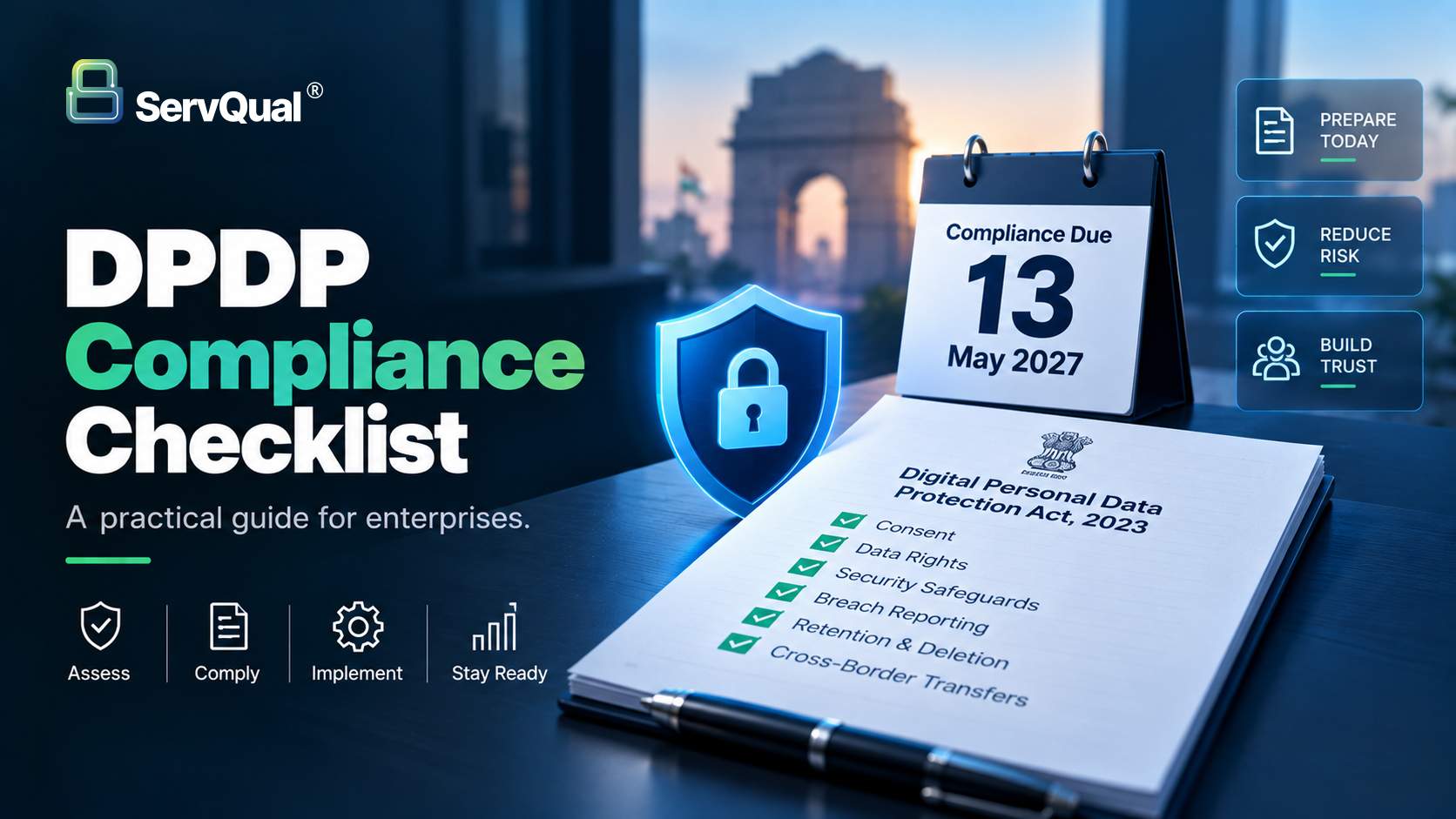
India’s Digital Personal Data Protection Act, 2023 (DPDP Act) and the DPDP Rules, 2025 become fully enforceable on 13 May 2027. [1][2][3] From that date, enterprises must meet legal duties on notice, consent, security, breach reporting, retention and individual rights. Penalties reach ₹250 crore for a single breach. [1]
As of October 2026, about seven months remain. Data mapping, consent redesign and vendor contract changes each take months, so the work has to start now.
This ServQual checklist turns the Act and the Rules into twelve areas of action. Each item names the section or rule behind it, so legal, security and IT teams can trace every task to the text. A five-phase roadmap shows what to finish by when.
Key facts at a glance
| Question | Answer | Source |
|---|---|---|
| When is full compliance due? | 13 May 2027 | [2][3] |
| When does Consent Manager registration open? | 13 November 2026 | [2][3] |
| What is the highest penalty? | ₹250 crore, for failing to take reasonable security safeguards | Schedule to the Act [1] |
| How fast must a breach be reported? | Without delay, with a detailed report to the Board within 72 hours | Rule 7 [2] |
| How long to resolve a grievance? | A published period of not more than 90 days | Rule 14 [2] |
| Who is a child? | Anyone under 18 | Section 2 [1] |
| Minimum log retention? | One year | Rules 6 and 8 [2] |
The DPDP timeline: three dates that matter
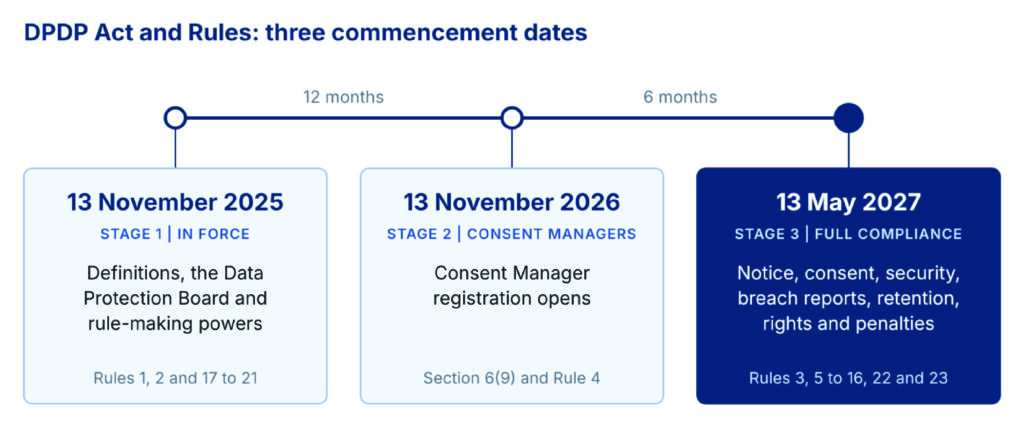
The Act and the Rules come into force in three stages, not on a single day. The Rules were notified on 13 November 2025, and the main obligations follow 18 months later. [2][3] Minor textual corrections to the Rules were published in December 2025. [4]
| Date | What comes into force | What it means for you |
|---|---|---|
| 13 November 2025 | Definitions, the Data Protection Board of India and rule-making powers (Rules 1, 2 and 17 to 21) | The enforcement body exists in law. No operational duty yet. |
| 13 November 2026 | Consent Manager registration (section 6(9) and Rule 4) | Relevant only if you plan to register as a Consent Manager. |
| 13 May 2027 | Notice, consent, security safeguards, breach reporting, retention, children's data, individual rights, Significant Data Fiduciary duties and penalties (Rules 3, 5 to 16, 22 and 23) | Full compliance is required. This is your deadline. |
Dates are counted from the Gazette publication of the Rules on 13 November 2025. Some government communications give 14 November 2025, which would move each date by one day. [6]
Two developments are worth tracking:
- A shorter timeline was discussed but never notified. In January 2026, press reports said the Ministry of Electronics and Information Technology (MeitY) proposed cutting the window for Significant Data Fiduciaries from 18 months to 12. No amendment has been published in the Gazette, so 13 May 2027 stands. [6] ServQual recommends that large enterprises still aim to be ready early.
- The Supreme Court challenge has not paused the law. The Court issued notice on petitions against parts of the Act in February 2026 and refused an interim stay. The framework continues to operate as notified. [6]
The Data Protection Board was established on 13 November 2025, and MeitY began selecting its Chairperson and four Members in May 2026. [5] The 18-month window is the transition period, so do not plan on a further grace period after May 2027.
Confirm your role before you start
Your obligations depend on the role you hold for each set of data. The Act covers digital personal data, including employee data, and it has no separate “sensitive data” category: the same duties apply to an email address and a health record. [1]
| Role | Who it is | Why it matters |
|---|---|---|
| Data Fiduciary | The entity that decides the purpose and means of processing | Carries almost all obligations and the penalty exposure |
| Data Processor | An entity that processes data on behalf of a Data Fiduciary | Bound mainly through its contract with the fiduciary |
| Significant Data Fiduciary | A Data Fiduciary notified by the Central Government under section 10 | Extra duties: Data Protection Officer, independent auditor, yearly impact assessment and audit [1][2] |
| Consent Manager | A company registered with the Board that lets individuals manage consent across fiduciaries | Optional intermediary; registration opens on 13 November 2026 [2] |
Most enterprises are Data Fiduciaries for their own customers and employees, and Data Processors for their clients. Map both roles, because your contracts must reflect each one.
The ServQual DPDP compliance checklist: 12 areas
Each item names the section of the Act [1] or the rule [2] it comes from.
1. Governance and ownership
- Name an executive owner for DPDP compliance, with board-level visibility.
- Designate a person who can answer questions about your data processing. Publish their business contact details on your website or app and include them in every reply to a rights request (section 8(9), Rule 9).
- Assess whether you are likely to be notified as a Significant Data Fiduciary. The factors include the volume and sensitivity of data you process and the risk to individuals’ rights (section 10).
- Approve a budget and a dated plan that ends before 13 May 2027.
2. Data inventory and legal grounds
- Complete your personal data inventory across systems, applications and vendors.
- Assign a legal ground to every purpose: consent (section 6) or one of the legitimate uses in section 7.
- Flag data about children and about persons with disabilities who have a lawful guardian (section 9).
- Flag every transfer of personal data outside India (section 16).
3. Privacy notice
- Give a notice with or before every consent request (section 5).
- Make the notice stand on its own. It must be understandable without reading your terms of service or any other document (Rule 3).
- Include an itemised description of the personal data, the specific purposes, and the goods, services or uses the processing enables (Rule 3).
- Include the link through which the individual can withdraw consent, exercise rights and complain to the Board (Rule 3).
- Offer the notice in English or any of the 22 languages in the Eighth Schedule to the Constitution, at the individual’s option (section 5(3)).
- For consent collected before the Act commenced, send a compliant notice as soon as reasonably practicable (section 5(2)).
4. Consent
- Check every consent flow against the six tests in section 6(1): free, specific, informed, unconditional, unambiguous, and given by a clear affirmative action.
- Make withdrawal as easy as giving consent, and make your processors stop processing after withdrawal (sections 6(4) and 6(6)).
- Keep records that prove notice was given and consent was obtained. The burden of proof is on you (section 6(10)).
ServQual covers this area in two dedicated guides: DPDP Consent Management and Purpose Limitation and the companion to this article, DPDP Consent Management: What Enterprises Need.
5. Rights of individuals and grievance redressal
- Publish how individuals can make a rights request, and which identifier they must provide (Rule 14).
- Publish the response period of your grievance redressal system. It must not exceed 90 days (section 13, Rule 14).
- Allow individuals to nominate someone to exercise their rights in case of death or incapacity (section 14).
An individual must use your grievance mechanism before approaching the Board (section 13(3)). [1] For the request-handling process itself, see ServQual’s guide to the DPDP DPAR workflow.
6. Security safeguards
Rule 6 sets a minimum list. [2] Check each one against your current controls.
- Protect personal data through encryption, obfuscation, masking or virtual tokens.
- Control access to the computer resources used for processing.
- Keep logs, and monitor and review them, so that unauthorised access can be detected, investigated and fixed.
- Maintain backups so processing can continue if data is lost or compromised.
- Retain those logs and the personal data for one year, unless another law requires otherwise.
- Write security obligations into every Data Processor contract.
- Put technical and organisational measures in place to make sure the safeguards are followed.
This is the area with the highest penalty: up to ₹250 crore. [1]
7. Personal data breach response
- Notify every affected individual without delay, in plain language. Cover the nature, extent and timing of the breach, the likely consequences, the steps you are taking, the safety measures they can take, and a contact person (Rule 7(1)).
- Send the Board an initial description of the breach without delay (Rule 7(2)).
- Send the Board a detailed report within 72 hours of becoming aware of the breach. It covers the facts and causes, mitigation, findings on who caused it, steps to prevent recurrence, and a report on the notices sent to individuals. The Board may allow more time on a written request (Rule 7(2)).
- Treat every personal data breach as notifiable. The Rules set no materiality threshold.
- Align the plan with the CERT-In directions, which require specified cyber incidents to be reported within six hours. [7]
- Test the plan with a simulated breach at least once before May 2027.
8. Retention and erasure
- Erase personal data when consent is withdrawn or the purpose is no longer served, unless a law requires you to keep it. Make your processors erase it too (section 8(7)).
- Keep personal data, traffic data and processing logs for at least one year from the date of processing, then erase them unless another law requires longer retention (Rule 8(3)).
- If you are a large platform listed in the Third Schedule, erase the data of users who have been inactive for three years, and warn them at least 48 hours before erasure (Rule 8).
- Write a retention schedule that reconciles DPDP with tax, company law and sector rules from regulators such as RBI, SEBI and IRDAI.
The Third Schedule applies to e-commerce entities and social media intermediaries with at least 2 crore registered users in India, and online gaming intermediaries with at least 50 lakh. [2]
9. Data Processors and vendors
- Engage a Data Processor only under a valid contract (section 8(2)).
- Remember that you remain responsible for compliance even when a processor does the work (section 8(1)).
- Add clauses on security safeguards, prompt breach reporting to you, stopping processing on withdrawal of consent, erasure, one-year log retention, audit rights and sub-processors.
- Rank vendors by the volume and nature of personal data they handle, and renegotiate the highest-risk contracts first.
10. Children and persons with disabilities
- Identify whether any of your users are under 18. The Act treats everyone under 18 as a child.
- Obtain verifiable consent from a parent before processing a child’s data (section 9(1), Rule 10).
- Verify that the person giving consent is an identifiable adult. You may rely on identity and age details you already hold, details the parent provides, or a virtual token from an authorised entity such as a Digital Locker service provider (Rule 10).
- For a person with a disability who has a lawful guardian, obtain the guardian’s verifiable consent and verify the guardianship (section 9(1), Rule 11).
- Do not track children, monitor their behaviour or direct targeted advertising at them (section 9(3)).
- Check whether a Fourth Schedule exemption applies. Limited exemptions exist for healthcare providers, educational institutions, crèches and certain safety purposes (Rule 12).
11. Cross-border transfers
- Map which countries your personal data goes to, including through cloud and support vendors.
- Monitor Central Government notifications. Transfers are permitted unless the Government restricts transfers to a notified country (section 16).
- Follow any requirements the Government specifies about making data available to a foreign State or its agencies (Rule 15).
- Apply stricter sector rules where they exist, such as RBI’s payment data storage requirements. The Act preserves them (section 16(2)).
12. Significant Data Fiduciary obligations
These apply only if the Central Government notifies you, or a class you belong to, as a Significant Data Fiduciary. [1]
- Appoint a Data Protection Officer who is based in India and responsible to your board of directors (section 10).
- Appoint an independent data auditor (section 10).
- Carry out a Data Protection Impact Assessment and an audit once every 12 months, and have the significant observations reported to the Board (Rule 13).
- Verify that the technical measures you use, including algorithmic software, are not likely to pose a risk to individuals’ rights (Rule 13(3)).
- Keep within India any personal data the Central Government specifies for localisation (Rule 13(4)).
Penalties for non-compliance
The Schedule to the DPDP Act sets maximum penalties by type of breach. The highest is ₹250 crore, for failing to take reasonable security safeguards. [1]
| Breach | Maximum penalty |
|---|---|
| Failure to take reasonable security safeguards to prevent a personal data breach (section 8(5)) | ₹250 crore |
| Failure to notify the Board or affected individuals of a personal data breach (section 8(6)) | ₹200 crore |
| Breach of obligations relating to children's data (section 9) | ₹200 crore |
| Breach of the additional obligations of a Significant Data Fiduciary (section 10) | ₹150 crore |
| Breach of any other provision of the Act or the Rules | ₹50 crore |
| Breach of a voluntary undertaking given to the Board (section 32) | Up to the amount applicable to the underlying breach |
| Breach of duties by a Data Principal (section 15) | ₹10,000 |
These are ceilings, not fixed amounts. Under section 33, the Board weighs the nature, gravity and duration of the breach, the type of personal data affected, whether the breach is repeated, any gain made or loss avoided, and the steps taken to mitigate it. [1]
That last factor matters. Documented safeguards, a tested breach plan and prompt notification all reduce exposure. The Act provides for monetary penalties payable to the Government. It does not provide for compensation to individuals. [1]
The ServQual five-phase roadmap to 13 May 2027
An enterprise starting in October 2026 can still finish on time, but only by working in parallel. ServQual’s five-phase roadmap fits the months that remain.
| Phase | When | What to finish |
|---|---|---|
| 1. Assess | October to November 2026 | Executive owner named, data inventory complete, gap assessment against the twelve areas, view on Significant Data Fiduciary status |
| 2. Design | December 2026 to January 2027 | New notices, consent flows, retention schedule, rights and grievance workflows, vendor contract template |
| 3. Build | February to March 2027 | Consent and preference systems live, security controls and logging upgraded, breach runbook written, high-risk vendor contracts amended, notices sent for legacy consent |
| 4. Test | April 2027 | Breach simulation, dry run of rights requests, internal audit of the checklist, staff training complete |
| 5. Go live | Before 13 May 2027 | All controls operating, evidence pack assembled, monitoring in place |
Start the data inventory and the vendor contracts first. The inventory feeds every other workstream, and contract changes depend on other companies’ legal teams.
Common mistakes to avoid
- Assuming GDPR compliance is enough. DPDP has no “legitimate interests” or “contract” ground, treats everyone under 18 as a child, and makes every breach notifiable. ServQual compares the regimes in DPDPA vs GDPR vs UK DPA.
- Leaving legacy data untouched. Consent collected before commencement needs a fresh notice under section 5(2).
- Treating breach reporting as a security-team task. The 72-hour report needs legal, communications and management input, agreed in advance.
- Forgetting the one-year floor. Logs and personal data must be kept for at least a year, even where the business purpose ends sooner (Rules 6 and 8(3)).
- Waiting for a deadline extension. None has been notified, and the reported discussion in January 2026 was about shortening the window. [6]
“DPDP compliance is not a single privacy task. It requires coordinated action across data inventory, consent, security, vendors, retention, breach response and individual rights.”

Vaishnavi Pawar
Security Researcher | ServQual
FAQ
Most frequent questions and answers
The article states that the main DPDP obligations and penalties become enforceable on 13 May 2027, including notice, consent, security safeguards, breach reporting, retention, children’s data and individual rights.
The highest penalty described in the article is ₹250 crore for failure to take reasonable security safeguards to prevent a personal data breach.
The article states that affected individuals and the Data Protection Board must be informed without delay, with a detailed report to the Board within 72 hours of becoming aware of the breach.
No. According to the article, a DPO is mandatory for a Significant Data Fiduciary. Other Data Fiduciaries must publish business contact details for a person who can answer questions about processing.
Yes. The article states that digital personal data relating to employees is covered, although section 7 permits certain processing for employment purposes without consent.
The checklist includes encryption or masking, access controls, logging and monitoring, backups, one-year retention requirements, Data Processor contractual safeguards, and technical and organisational measures.
The article recommends starting with the data inventory and vendor contracts, because the inventory feeds other compliance workstreams and contract changes can take time.
Prepare for DPDP Before the Deadline
Assess your current DPDP posture, identify gaps and build a practical compliance roadmap with ServQual and SUSAN.
Disclaimer:This checklist is provided for general informational and compliance-readiness purposes and does not constitute legal advice. Regulatory requirements, interpretations and implementation timelines may change. Organisations should obtain appropriate legal and professional advice for their specific circumstances.