Short Summary
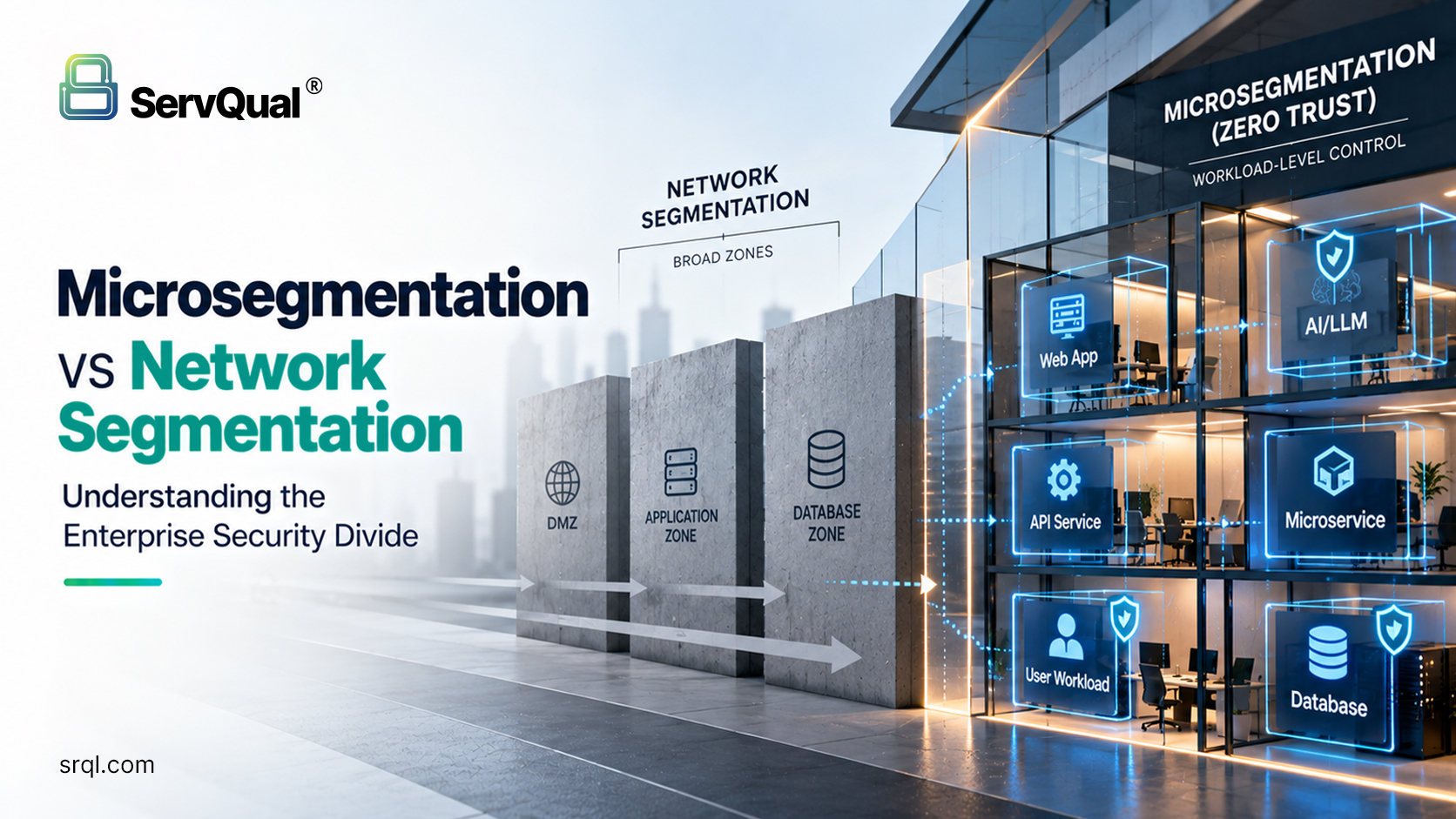
Network segmentation and microsegmentation are often confused as interchangeable, but they represent fundamentally different security architectures. Traditional network segmentation divides the network into broad zones – DMZ, internal network, database tier – and enforces security at zone boundaries with firewalls. Microsegmentation goes deeper, creating security zones around individual workloads, applications, and services. A user in the same zone has access to all other resources in that zone; in a microsegmented environment, a user with compromised credentials cannot freely move laterally across the network. For enterprises defending against advanced persistent threats and insider threats, microsegmentation is the modern requirement. But many organizations still rely on legacy network segmentation and do not realize the security gap.
The Problem
Enterprise security teams face a critical architecture gap:
- Traditional network segmentation assumes the boundary is secure. Once inside a zone, users and workloads can access other resources with minimal additional controls.
- Lateral movement within a segmented zone is often unmonitored. An attacker who compromises one server can pivot to others in the same zone without triggering alerts.
- Segmentation rules are maintained manually, updated infrequently, and rarely validated. Ghost rules accumulate, creating hidden pathways attackers can exploit.
- Cloud environments and containerized applications move faster than traditional segmentation can accommodate. New workloads spin up and are plugged into existing network zones without new security policies.
- Compliance frameworks like PCI DSS and HIPAA mandate segmentation, but traditional network segmentation alone no longer satisfies security requirements or the intent of regulatory expectations.
The result: enterprises report billions spent on network infrastructure and security appliances, yet most breaches involve lateral movement within segmented zones.
Why It Matters
The average dwell time for a sophisticated attacker before detection is 207 days, according to the 2023 MANDIANT M-Trends report. During that time, attackers are moving laterally within the network, escalating privileges, and exfiltrating data. Traditional network segmentation cannot stop this movement.
Microsegmentation fundamentally changes the equation. By enforcing security controls at the workload level rather than the zone level, an attacker cannot freely move from one compromised host to another. Every lateral movement attempt requires explicit authorization based on identity, device posture, and application context. This reduces dwell time, limits breach blast radius, and forces attackers to spend more resources to achieve their objectives.
For enterprises handling sensitive data or operating in regulated industries, microsegmentation is increasingly expected by frameworks like NIST CSF (Identify and Protect controls), Zero Trust Architecture mandates, and customer security assessments.
Technical Explanation: Segmentation Architecture Comparison
Traditional Network Segmentation
Architecture: Networks are divided into logical zones (DMZ, internal network, database tier, guest network). Security appliances (firewalls, intrusion detection systems) enforce policies at zone boundaries. Within a zone, east-west traffic may be allowed with few restrictions.
Authentication: Typically occurs once at the network boundary (VPN login, network access control on port 802.1X). After authentication, lateral movement within the zone requires no re-authentication.
Enforcement Points: Firewalls at network boundaries. Intra-zone traffic is either fully allowed or subject to simple firewall rules based on IP addresses and ports.
Scaling Challenges: Adding new applications or workloads to a zone requires updating network diagrams and firewall rules. This process is manual, slow, and error-prone.
Visibility: Network traffic flows are monitored at the boundary. Lateral movement within zones is often not logged or monitored in detail.
Microsegmentation (Zero Trust)
Architecture: The network is not trusted as a security boundary. Every workload is treated as its own security zone. Communication between workloads requires explicit authorization based on identity, device posture, application context, and behavioral analysis.
Authentication: Continuous. Every workload connection is authenticated and authorized independently. Compromised credentials on one workload cannot be leveraged to access other workloads without meeting additional security requirements.
Enforcement Points: Distributed. Security controls are enforced at multiple layers – host firewalls, container runtime, API gateways, service meshes. Policies are defined per-workload or per-service.
Scaling Advantages: Policies are typically defined based on service or application behavior, not IP addresses. New workloads automatically inherit security policies based on application identity and tags.
Visibility: Every lateral movement attempt is logged and can be analyzed. Behavioral anomalies trigger alerts in real time.
Compliance & Regulatory Context
PCI DSS Requirement 1.3 mandates network segmentation and segregation of cardholder data environment (CDE) from other networks. While PCI DSS accepts traditional network segmentation, auditors increasingly expect evidence of controls against lateral movement within segmented zones.
HIPAA Security Rule Section 164.312(a)(2)(i) requires network segmentation and requires measures to protect ePHI. Guidance documents increasingly reference Zero Trust and microsegmentation as best practices.
NIST Zero Trust Architecture (NIST SP 800-207) recommends that organizations implement microsegmentation at the application or workload level, not just the network level.
CIS Controls v8 (formerly CIS Top 20) Control 1.3 (Network Segmentation) expects organizations to implement Zero Trust principles and microsegmentation rather than relying on perimeter security alone.
Without evidence of microsegmentation or Zero Trust implementation, auditors will flag segmentation controls as incomplete.
Example Use Case
A healthcare organization implemented traditional network segmentation: separate zones for clinical systems, administrative systems, and patient data repositories. A phishing email infected a user workstation in the administrative zone. Within 48 hours, attackers escalated privileges and pivoted to the patient data repository in the same zone, exfiltrating records of 250,000 patients. The breach triggered HIPAA violations and OCR fines totaling $2.8 million.
After implementing microsegmentation with a zero-trust service mesh, the same attack scenario played out differently. The compromised workstation could not access the patient data repository because the service mesh enforced explicit authorization based on workload identity. The attacker’s pivot attempt was blocked and logged. The security team detected the lateral movement attempt in real time and isolated the compromised workstation within minutes.
The difference was not better perimeter defenses. It was the elimination of the trust assumption within the network zone. Every lateral movement attempt required proof of authorization.
Network Segmentation vs Microsegmentation Comparison
| Aspect | Traditional Segmentation | Microsegmentation |
|---|---|---|
| Trust Model | Boundary trust - resources within zone are trusted | Zero trust - every workload requires authorization |
| Enforcement Level | Network zone (large blast radius) | Workload / application level (small blast radius) |
| Lateral Movement | Possible within zones with minimal controls | Blocked unless explicitly authorized |
| Scaling | Manual rule updates; slow deployment | Policy-driven; automatic for new workloads |
| Cloud/Container Ready | Difficult; IPs and zones change frequently | Native; workloads identified by service, not IP |
| Compliance Fit | Meets minimum requirements | Exceeds best practices; future-proof |
| Dwell Time Impact | Minimal; attackers move freely within zones | High impact; every move blocked or logged |
Microsegmentation Implementation Checklist
- Asset Inventory: Map all workloads, applications, and services. Identify data flows and dependencies.
- Zero Trust Readiness Assessment: Evaluate current authentication, authorization, and monitoring capabilities.
- Decommission Legacy Rules: Audit existing network segmentation rules. Remove ghost rules and rules based on obsolete infrastructure.
- Implement Identity-Based Policies: Define policies based on workload identity, not IP addresses. Use service identity (certificates, tokens) instead of IP as trust anchor.
- Deploy Microsegmentation Tools: Service mesh (Istio, Consul), zero-trust network access (BeyondCorp, Zscaler), or host-based firewalls (Falco, Cilium).
- Enable Continuous Authentication: Implement certificate-based authentication with short-lived credentials. Require re-authentication for sensitive operations.
- Monitoring & Alerting: Log all authorization decisions. Alert on denied or anomalous lateral movement attempts.
- Compliance Mapping: Map microsegmentation controls to regulatory frameworks (PCI DSS, HIPAA, NIST CSF). Document enforcement.
- Incident Response Integration: Update incident response procedures to include microsegmentation containment and forensics.
- Regular Audits: Review segmentation policies quarterly. Validate that segmentation rules align with current application architecture.
How ServQual Can Help
ServQual helps enterprises assess their current segmentation architecture and design microsegmentation strategies aligned with application dependencies, threat models, and regulatory requirements. This includes threat modeling, workload mapping, zero-trust architecture design, and implementation validation.
The challenge with microsegmentation is that it generates enormous amounts of policy and traffic data. Defining policies correctly is hard; validating that those policies are enforced correctly is harder. Many organizations deploy microsegmentation tools without the visibility to know whether the controls are working.
SUSAN, ServQual’s AI-powered Cybersecurity, Privacy, and GRC platform, ingests segmentation policies and traffic data to provide continuous visibility into segmentation enforcement. SUSAN’s AI-Driven Risk Intelligence detects when segmentation policies are unenforced, misconfigured, or violated. It explains the business impact of each segmentation gap: a service that can reach the database tier without authorization, a workload accepting traffic from unapproved sources, or a policy that blocks legitimate business traffic.
SUSAN maps segmentation controls to compliance frameworks. For PCI DSS, it validates that cardholder data environment segregation is enforced and monitored. For HIPAA, it ensures ePHI repositories are protected by microsegmentation. Risk scores update continuously as segmentation enforcement gaps are identified and remediated.
For organizations implementing microsegmentation, SUSAN becomes the control plane for policy definition, enforcement monitoring, anomaly detection, and audit evidence. Without continuous monitoring, microsegmentation is just policy on paper.
“Traditional network segmentation assumes zones are safe internally. Microsegmentation assumes nowhere is safe without explicit authorization.”

Ankit Sharma
VAPT Engineer | ServQual
FAQ
Most frequent questions and answers
Traditional network segmentation divides infrastructure into broad zones and enforces controls at zone boundaries. Microsegmentation applies security policies at the workload, application or service level.
Microsegmentation reduces implicit trust inside network zones. Workload communication requires explicit authorization rather than assuming that everything inside a network segment is trusted.
The article states that PCI DSS and HIPAA can use traditional segmentation, but enterprises may still need to demonstrate how lateral movement is prevented and monitored within segmented zones.
No. It can be applied across on-premise, cloud and hybrid environments, although cloud and container environments can make workload identity and policy automation easier.
VLANs create logical network segments, but devices within the same VLAN may still communicate unless additional controls are applied. Microsegmentation can enforce workload-level controls independently of VLAN placement.
Start with asset inventory, workload and application mapping, data-flow discovery, Zero Trust readiness, legacy-rule review, identity-based policy design and monitoring requirements.
The article describes SUSAN as providing visibility into segmentation policies and traffic, detecting unenforced or misconfigured policies, and mapping segmentation controls to compliance frameworks.
Strengthen Segmentation with Zero Trust
Assess your current segmentation architecture, identify lateral-movement exposure and build a practical microsegmentation roadmap with ServQual.
Disclaimer: This article is provided for general Network Security and Zero Trust guidance. Segmentation architecture, implementation approach and control requirements depend on the organisation’s network design, workloads, threat model, regulatory obligations and operational constraints.