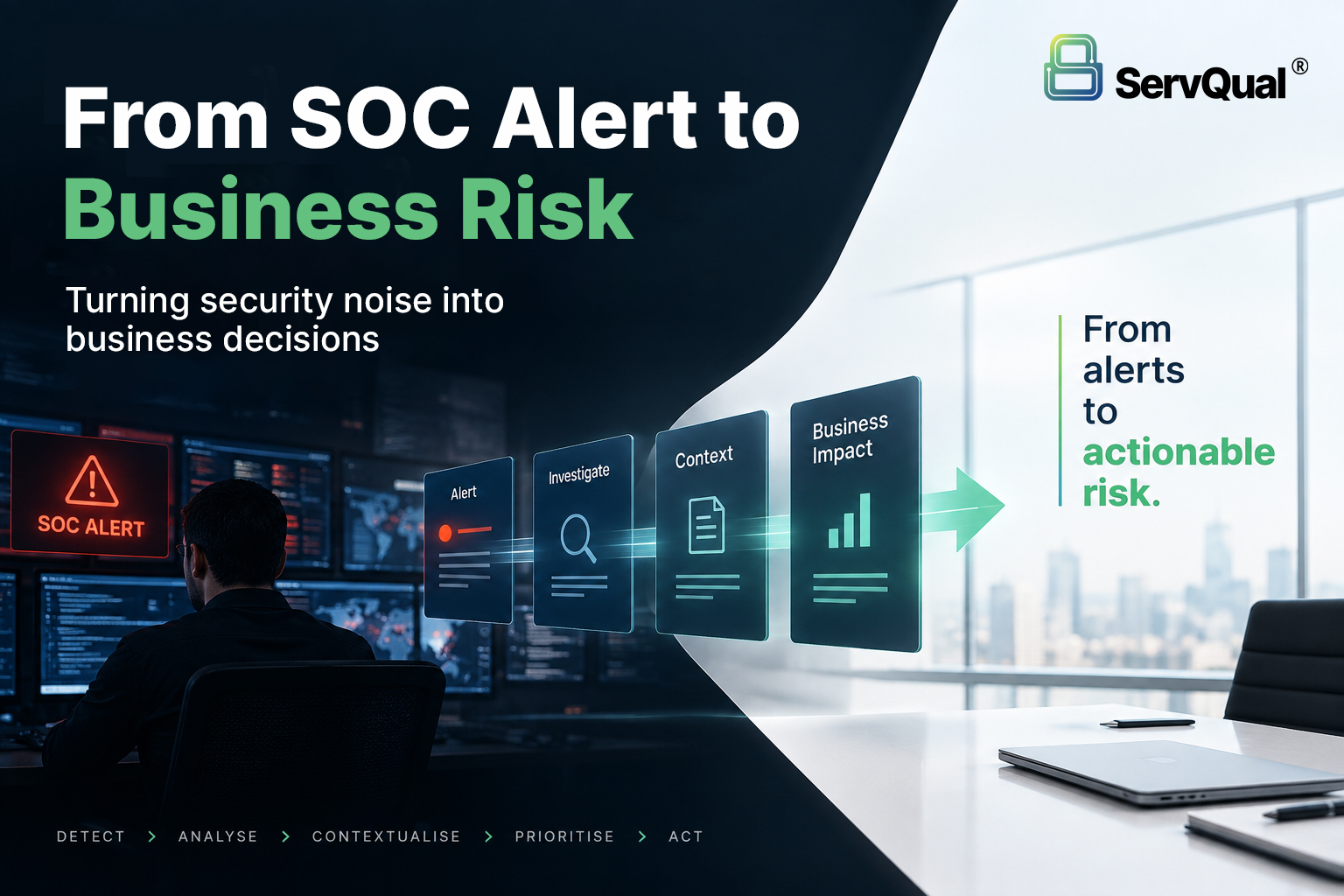
SOC alerts become business risk when security telemetry is mapped to risk scenarios, enriched with asset and identity context, converted into Key Risk Indicators and fed into the enterprise risk register.
A mature SOC and GRC connection should link alerts to business impact, affected assets, data sensitivity, control effectiveness, regulatory exposure, remediation ownership and board reporting. This helps leadership understand why a security event matters, not only that an alert occurred.
Executive Summary
Security Operations Centers generate large volumes of alerts every day, while GRC teams often manage risk registers on monthly or quarterly cycles. When these functions stay disconnected, SOC alerts lack business context and risk registers become stale.
The solution is to create a translation layer between security operations and governance. SOC detections should map to business-aligned risk scenarios, and top enterprise risks should be observable through SOC telemetry.
This requires a common risk taxonomy, enrichment with asset and identity context, Key Risk Indicators, formal incident handoff into the risk register and a feedback loop from governance back into detection engineering.
Done properly, the SOC becomes more than a monitoring desk. It becomes a source of evidence for business risk, control effectiveness, remediation prioritization and leadership decision-making.
Why SOC and GRC Teams Drift Apart
The drift is structural, not a failure of goodwill. The SOC lives in seconds and hours: SIEM, EDR and XDR consoles, triage queues, escalation clocks and shift handovers. The GRC function lives in months and quarters: risk registers, control frameworks, audit calendars and committee packs. Each side produces artifacts the other cannot use. An analyst closing forty alerts a shift has no field for business impact, and a risk manager updating the register has no feed telling them that the ransomware scenario they rated as unlikely has generated thirty precursor detections this quarter.
The result shows up in both directions. Risk registers describe threats in language no detection rule can observe, so likelihood ratings are refreshed by opinion rather than evidence. Meanwhile SOC metrics count alerts, mean time to respond and false positive rates, none of which tells a board whether the organization’s actual exposure moved. Two teams, both diligent, produce reporting that never meets.
Why SOC Alerts Need Business Context
A raw alert answers one question: something matched a rule. It does not answer the questions that determine what should happen next. Is the affected server a test box or the payments database? Is the account a contractor’s or a domain administrator’s? Does the data involved fall under a regulatory regime with a reporting clock? Two identical detections can represent trivial noise or a material event, and only business context separates them.
Context changes behavior on both sides of the divide. For the SOC, it drives honest prioritization: a medium-severity detection on a crown-jewel system outranks a high-severity detection on an isolated lab machine. For GRC and leadership, it turns a stream of technical events into an answer to the question they are actually paid to ask: which of our top risks is getting more likely, and are the controls we funded holding? The five steps below build that translation layer.
Step 1: Build a Common Risk Taxonomy
Start by defining 8 to 15 business-aligned cyber risk scenarios that both functions will use as their shared vocabulary. Good scenarios are concrete enough to detect and broad enough to matter: ransomware disrupting operations, business email compromise leading to fraudulent payment, theft of regulated customer data, insider misuse of privileged access, compromise through a supplier connection, cloud misconfiguration exposing data. Each scenario should already exist in, or be added to, the enterprise risk register with an owner and an impact rating.
Then map SOC detection categories to those scenarios: phishing detections and mailbox rule alerts feed the business email compromise scenario, encryption behavior and shadow copy deletion feed ransomware, mass download and exfiltration alerts feed data theft. Where useful, use MITRE ATT&CK techniques as the connective tissue, because a technique-level mapping links attacker behavior, detection coverage and risk scenario in one line. The mapping does not need to be exhaustive on day one; covering the top scenarios with the highest-volume detection categories already changes what reporting can say.
Step 2: Enrich Alerts with Business Context
Mapping tells you which risk an alert belongs to; enrichment tells you how much it matters. At triage time, every alert should carry asset criticality, data classification, identity privilege level, exposure, business owner and process dependency, drawn automatically from the CMDB, identity provider and data inventory rather than looked up by hand. Two enrichment questions deserve special weight: is regulated data involved, and is a crown-jewel system involved, because those answers change escalation paths, potential reporting obligations and the risk records an incident should generate.
Enrichment quality is inherited, not created, by the SOC. If the asset inventory is stale or ownership fields are empty, alerts inherit that blindness. Treat gaps discovered during triage as findings in their own right: every alert that cannot be tied to an owner or a classification is evidence for the data governance program, and closing those gaps compounds across every future alert.
Step 3: Translate Alert Volume into Key Risk Indicators
Individual alerts are weather; leadership needs climate. Key Risk Indicators convert alert patterns into measurable signals that show whether a risk scenario is becoming more or less likely. Examples: confirmed ransomware precursor incidents per quarter, privileged access anomalies per month, repeated vendor remote access alerts, phishing messages reported versus clicked, mean dwell time for incidents in a given scenario.
Each KRI needs three things to be more than a chart: a threshold that defines when the signal is abnormal, an owner accountable for responding when the threshold is crossed, and a defined consequence, such as triggering a risk reassessment or a control review. Choose few and choose deliberately: a handful of KRIs tied to the top scenarios, reviewed on a fixed cadence, beats a dashboard of forty metrics nobody owns.
Step 4: Feed Incidents into the Risk Register
Define in advance when a SOC incident updates the risk register, so the handoff is a rule rather than a judgment call made during a crisis. A workable trigger: any high-severity incident, any incident touching regulated data or crown-jewel systems, and any recurring pattern that crosses a KRI threshold. For those, the incident process should produce a structured risk record: the scenario affected, the controls that failed and the controls that worked, estimated business impact, root cause and recommended treatment.
The controls dimension is the most valuable and the most often skipped. An incident is a free, unscheduled control test. If email filtering missed the payload but EDR contained it, that is evidence about two controls that no audit sampling would produce. Captured consistently, this record stream keeps residual risk ratings honest: likelihood reflects what the environment actually experienced, and control effectiveness reflects observed performance rather than design intent.
Step 5: Close the Loop from Governance to Operations
The flow must run both ways. When the risk committee names its top scenarios for the year, that priority list should reach detection engineering as a work order: which techniques for those scenarios lack detection coverage, which playbooks are missing or untested, which log sources are absent. A risk the register rates as critical but the SOC cannot observe is a defined gap, and it should be treated like one.
Institutionalize the loop with a recurring review, monthly or quarterly, that brings the SOC, threat intelligence and risk management to the same table. The agenda writes itself: KRI movements against thresholds, incidents that generated risk records, detection coverage against top scenarios, and threat intelligence that argues for re-rating a risk. This single meeting is where the translation layer either lives or dies, because it forces both vocabularies into one conversation with decisions attached.
Operating Model and Roles
The connection needs named owners, not a shared aspiration. A workable minimum: the SOC lead owns detection-to-scenario mapping and KRI production; the risk manager owns the register, the scenario set and the risk records that incidents generate; a threat intelligence function, even part time, owns the argument for which scenarios deserve attention next; and control owners receive and act on the control effectiveness evidence incidents produce. Leadership’s role is to consume scenario-level reporting and make resource decisions against it, which only works if the reporting reaches them in business language.
Tooling should serve this model rather than define it. The essential integration is modest: alerts and incidents carry a scenario tag and enrichment fields, and the risk platform can receive structured records from the incident process. Whether that is achieved through a GRC platform, a SOAR integration or a disciplined shared workspace matters less than whether the fields exist and are filled.
What Good Looks Like
Mature organizations report scenario-level trends instead of alert counts. The board pack says that ransomware exposure trended down after segmentation and EDR coverage improvements, evidenced by precursor incidents falling from twelve to three per quarter, rather than reporting that the SOC processed forty thousand alerts. Risk register entries cite incident evidence and KRI movement in their likelihood rationale. Detection engineering backlogs reference risk priorities. And when an auditor or regulator asks how leadership stays informed about cyber risk, the answer is a documented pipeline from telemetry to scenario to register to board, with evidence at every joint.
A useful test: pick your organization’s top-rated cyber risk and ask two questions. Which SOC detections would fire if that scenario began unfolding today, and when did an operational signal last change that risk’s rating? If the first has no answer, the risk is unobserved. If the second is “never,” the register is running on opinion.
SOC Alert to Business Risk Checklist
Organizations connecting SOC monitoring with GRC should validate the following:
- Define 8 to 15 business-aligned cyber risk scenarios.
- Map SOC detection categories to each risk scenario.
- Use MITRE ATT&CK techniques where useful to connect detections with attacker behavior.
- Enrich alerts with asset criticality, data classification, identity privilege and business ownership.
- Identify whether regulated data or crown-jewel systems are involved.
- Convert alert patterns into Key Risk Indicators with thresholds and owners.
- Define when SOC incidents should update the risk register.
- Capture control failures, control success and residual risk impact after incidents.
- Feed top GRC risk priorities back into detection engineering and playbook design.
- Hold a recurring SOC, threat intelligence and risk management review.
- Report scenario-level trends to leadership instead of only alert counts.
- Maintain evidence linking alerts, incidents, controls, remediation and risk decisions.
How ServQual and SUSAN Help
ServQual helps organizations strengthen SOC monitoring, incident response, threat hunting, managed security, GRC, audit readiness and continuous assurance.
SOC and GRC alignment should not depend on manual copying between alert queues and risk registers. Security findings need business context, regulatory context, remediation ownership and evidence that leadership can trust.
SUSAN can help teams connect SOC findings, business risk exposure, control effectiveness, remediation status and compliance evidence into one governance view. This helps SOC, GRC, security, risk and leadership teams understand which alerts matter most and how operational security events affect the risk register.
With ServQual and SUSAN, organizations can:
- Connect SOC alerts to business risk scenarios
- Map incidents to regulatory and compliance impact
- Track control effectiveness and remediation ownership
- Convert technical signals into leadership-ready risk visibility
- Maintain audit-ready evidence for incidents and remediation
- Support executive and Board reporting
- Align SOC operations with GRC and continuous assurance
- Move from alert handling to risk-informed security operations
Explore SUSAN: https://srql.com/services/susan/
Explore Incident Response & Managed Security: https://srql.com/services/incident-response-managed-security/
Explore Governance, Risk, Compliance & Audits: https://srql.com/services/governance-risk-compliance-audits/
Explore Cybersecurity Services: https://srql.com/services/cyber-security-solutions/
"A SOC alert becomes business risk only when it explains what is affected, why it matters and who must act."

Jayesh Thakkar
Solutions Consultant | ServQual
FAQ
Most frequent questions and answers
It means mapping security alerts and incidents to business risk scenarios, affected assets, data sensitivity, control effectiveness, remediation ownership and leadership reporting.
SOC teams work in real-time alerts and incidents, while GRC teams work in risk registers, controls, frameworks and reporting cycles. Without a shared taxonomy, the two functions use different language.
Alert-to-risk mapping links SOC detection categories, such as phishing, ransomware behavior or privilege escalation, to enterprise risk scenarios in the risk register.
Useful context includes asset criticality, data classification, identity privilege, exposure level, business owner, process dependency and regulatory relevance.
Security Key Risk Indicators are measurable signals that show whether a risk scenario is becoming more or less likely. Examples include ransomware incidents, privileged access anomalies or repeated vendor access alerts.
High-severity incidents should create structured risk records showing the scenario affected, controls that failed or worked, estimated impact, root cause and recommended treatment.
MITRE ATT&CK helps connect technical attacker behavior to risk scenarios, detection use cases, control gaps and threat-informed reporting.
SUSAN can help connect SOC findings with business risk exposure, regulatory impact, control effectiveness, remediation workflows, compliance dashboards and audit-ready evidence.
Connect SOC Alerts to Business Risk
SOC alerts should not disappear into triage queues while risk registers are updated by opinion. Security telemetry should help explain which business risks are increasing, which controls are working, which assets are exposed and which remediation actions need ownership.
ServQual helps organizations strengthen SOC monitoring, incident response, threat hunting, GRC alignment and audit-ready evidence. Explore SUSAN or contact ServQual to connect alerts, incidents, controls, remediation, KRIs and board-ready risk reporting into one Continuous Assurance view.
Disclaimer: This article is provided for general informational purposes only and does not constitute legal, regulatory or security advice. Risk management practices, regulatory reporting obligations and security operations requirements vary by organization, sector and jurisdiction. Organizations should consult qualified advisors for guidance on their specific circumstances.