Executive Summary
Most security operations centres still rank alerts by technical severity, using CVSS scores and vendor ratings. As I worked through the evidence for this article, one pattern kept repeating: those scores are silent on the things that now cost an enterprise the most, namely regulated data, legal deadlines and customer trust. A CVSS 9.8 on an isolated test box can outrank a quieter event on a system that, if compromised, starts a regulatory clock. Regulators have changed the stakes. NIS2 expects an early warning within 24 hours, GDPR a breach notification within 72 hours, and DORA an initial report within roughly four hours. This article argues for a regulatory impact scoring model that enriches SIEM, EDR and XDR alerts with data sensitivity, asset criticality and reporting obligations. I show it working through a global financial-services scenario, give an architecture and an ASCII reference diagram, and close with how to secure the retrieval pipelines that AI-assisted SOCs increasingly depend on.
Why Severity-Based Prioritization Is Failing
The first problem is volume. Reading the operational data, the average enterprise SOC now receives over 4,400 alerts per day, with analysts investigating only about 37 percent of them and more than half of SIEM alerts turning out to be false positives. Palo Alto Networks puts the same point structurally: large enterprises run an average of 70 or more security tools, and the result is fatigue rather than coverage. When everything is critical, nothing is.
The second problem is that CVSS measures technical severity, not business consequence. It is the right tool for machine-scale triage, but it cannot tell you whose data sits behind an alert or which law applies. CISA makes this explicit. As I read its guidance, the agency recommends that organisations not rely on CVSS, or even the KEV catalog, as the only criterion and instead pair them with a decision framework such as SSVC that uses inputs appropriate to the organisation. The Binding Operational Directive 22-01 exists precisely because raw scores do not separate the vulnerabilities causing harm now from the thousands that are not.
The cost of this gap is not theoretical. In the 2013 Target breach the tooling worked and flagged the malicious activity, but the alerts were buried in routine noise and deprioritised, and data on tens of millions of payment cards was taken. The lesson I draw is that detection was never the failure. Prioritisation was.
The Rise of Regulatory-Aware Security Operations
Regulation now sets both the clock and the stakes for incident handling. A single event can trigger several regimes at once. Under NIS2 Article 23, essential and important entities must file a 24-hour early warning, a 72-hour notification and a final report within one month, with administrative fines reaching up to 10 million euros or 2 percent of global turnover. Under GDPR Articles 33 and 34, a personal data breach must be reported to the supervisory authority within 72 hours. For financial entities, DORA adds an initial report within roughly four hours, the tightest deadline in EU law. A ransomware event in a regulated firm can start all three clocks from the same minute.
What I find most useful for practitioners is ENISA’s NIS2 Technical Implementation Guidance, published in June 2025. It translates the Article 21 risk-management obligations of Commission Implementing Regulation (EU) 2024/2690 into 13 thematic areas, each with examples of evidence an auditor would expect and mappings to ISO/IEC 27001 and NIST CSF 2.0. The practical message is direct: regulators now expect you to demonstrate detection, classification, evidence collection and timely reporting. Once reporting obligations are wired into the rules, alert prioritisation stops being an internal efficiency question and becomes a compliance control in its own right.
Understanding SIEM, EDR, and XDR Through a Business Lens
EDR (Endpoint Detection and Response). Borrowing the analogy from Palo Alto Networks, EDR works like a microscope focused on endpoints. It sees in detail what happens on a single laptop or server: the process that launched, the file that was dropped, the command that ran. It is precise, but its view stops at the device edge.
XDR (Extended Detection and Response). XDR is the wide-angle lens across the whole enterprise. It connects endpoint activity with identity, email and cloud signals and assembles them into a single story, so an analyst can see that a phished credential, an unusual login and a data pull are one campaign rather than three unrelated alerts.
SIEM (Security Information and Event Management). SIEM is the system of record and the reporting backbone. It is the long-term memory of the environment and, for this discussion, the natural place to join business and regulatory context to raw telemetry. Gartner’s SIEM market research tracks this shift toward platforms that add context and analytics on top of collection. In plain terms: EDR tells you a device is sick, XDR tells you the illness is spreading and where, and SIEM tells you whether the patient is a regulated system whose compromise starts a 72-hour clock.
Building a Regulatory Impact Scoring Model
To act on consequence rather than severity, an alert needs a score built from business and regulatory inputs, not only threat inputs. The model below scores seven factors from 0 to 100, applies the weights shown, and produces a single regulatory impact score. The weighting is deliberate: data sensitivity, regulatory coverage and reporting obligations together carry more than half the score, because they drive the legal and financial outcome. Threat context still matters and should incorporate active exploitation signals such as the CISA KEV catalog, but it is weighted to inform, not dominate.
| Scoring Factor | What It Measures | Weight |
|---|---|---|
| Data Classification | Sensitivity of affected data, from public to restricted or regulated | 20% |
| Regulatory Coverage | Which regimes apply: GDPR, NIS2, DORA, sector rules | 20% |
| Asset Criticality | Importance of the affected system to core operations | 20% |
| Reporting Obligations | Whether a confirmed event triggers mandatory notification | 15% |
| Business Service Dependency | How many services or customers depend on the asset | 10% |
| Threat Context | Active exploitation, attacker behaviour, KEV listing | 10% |
| Likelihood of Exploitation | Reachability, exposure and exploit maturity | 5% |
Score bands: 0 to 24 Low, 25 to 49 Moderate, 50 to 74 High, 75 to 100 Critical. The band, not the raw CVSS, drives queue order.
Enterprise Architecture for Regulatory-Aware Prioritization
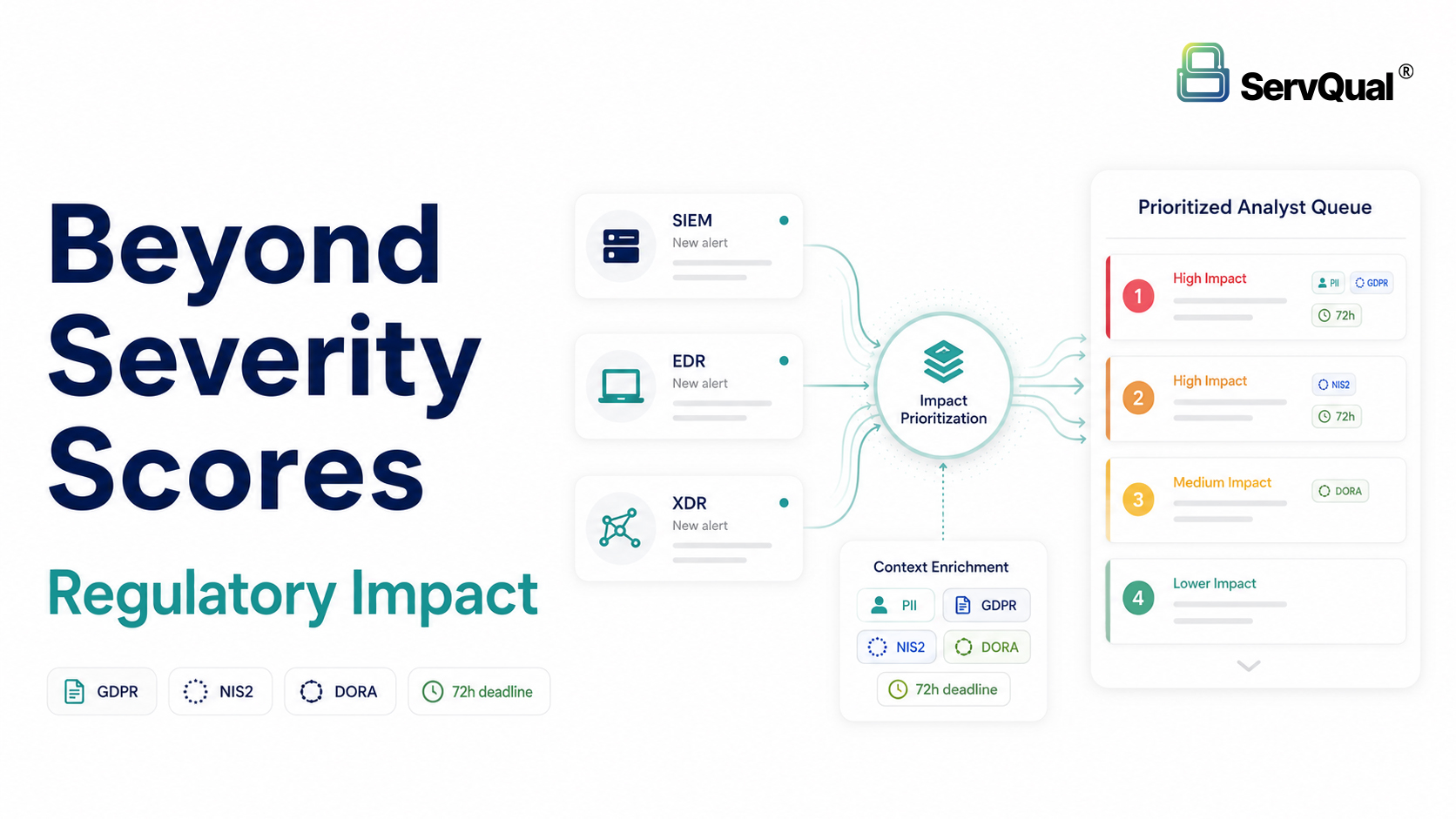
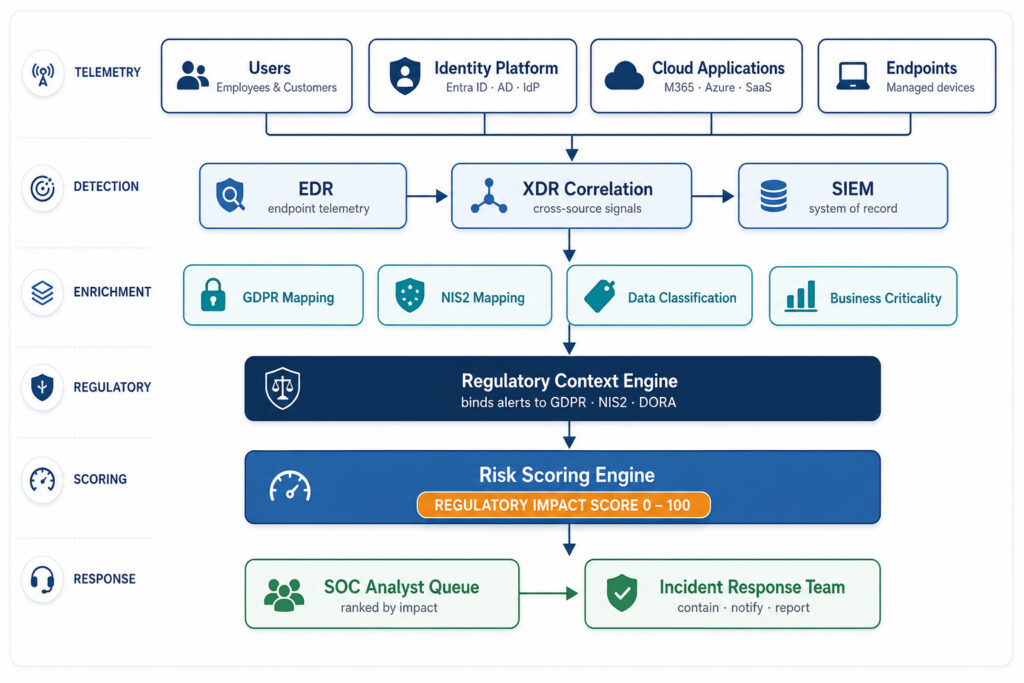
The architecture does one thing well: it makes context travel with the alert. You tag assets and data once, at the source, in the configuration management database, the data classification scheme and a regulatory register. Each alert is then enriched with five inputs as it moves through the pipeline: a regulatory tag, a data classification tag, a business criticality tag, the relevant compliance mapping, and the resulting risk score. A regulatory context engine binds each alert to its GDPR, NIS2 or DORA mapping, a risk scoring engine produces the impact score, and the analyst queue is ordered by that score. The analyst opens a case that already states whose data is involved, which regulation applies and which deadline may have started. Decisions get faster because the consequence is visible before the investigation begins.
Real-Life Enterprise Scenario
Organisation: a global financial services enterprise running Microsoft 365, Azure, Active Directory, a hybrid cloud estate, managed endpoints, and a SOC built on SIEM, EDR and XDR. Two alerts arrive in the same minute.
Alert A: a CVSS 9.8 vulnerability detected on a non-production development server, isolated, holding no customer data.
Alert B: suspicious authentication activity targeting the customer identity platform, which holds regulated customer information governed by GDPR and NIS2.
- How a traditional SOC would prioritise. Severity-first triage promotes Alert A immediately, because 9.8 outranks the medium severity usually assigned to anomalous logins.
- Why that is flawed. Alert A is contained, reaches no regulated data and triggers no reporting duty. Alert B touches live customer identities and may already be an active intrusion.
- Regulatory implications. Alert B can start the GDPR 72-hour and NIS2 24-hour clocks, and as a financial entity the firm also faces the DORA initial report. Alert A starts none.
- Business implications. Alert B risks customer data exposure, regulatory fines and loss of trust. The relevant benchmark is the global average cost of a breach, which IBM put at about 4.44 million US dollars in 2025. Alert A, at worst, costs a server rebuild.
- Correct prioritisation. Under the model, Alert B scores Critical and Alert A scores Low, as the worked table below shows. The severity ranking is inverted by consequence.
- Response workflow. For B: isolate the suspect sessions, force credential resets, preserve identity and sign-in logs as evidence, and start the reporting decision clock. Alert A is parallel-tracked as routine patching.
- Executive reporting. Leadership is briefed in business terms: which customers are affected, which regulators may need notifying and which deadlines are running, not the CVSS number.
- Lessons learned. Tag identity assets with regulatory context in advance, pre-agree the notification thresholds with legal, and rehearse the 24-hour clock so the first hour is execution, not debate.
Worked scoring: the same two alerts
| Factor (Weight) | Alert A (Dev Server) | Alert B (Identity Platform) |
|---|---|---|
| Data Classification (20%) | 10 | 100 |
| Regulatory Coverage (20%) | 0 | 100 |
| Asset Criticality (20%) | 20 | 95 |
| Reporting Obligations (15%) | 0 | 100 |
| Business Service Dependency (10%) | 10 | 90 |
| Threat Context (10%) | 40 | 80 |
| Likelihood of Exploitation (5%) | 70 | 75 |
| Regulatory Impact Score | 15 (Low) | 95 (Critical) |
CVSS would have ranked A above B. Regulatory impact scoring ranks B far above A, which matches the actual exposure to the business and its regulators.
Reference Architecture: Regulatory-Aware Alert Pipeline
The architecture below shows how telemetry rises from users to the SIEM, how enrichment inputs bind each alert to its regulatory context, and how the scoring engine then orders the analyst queue by impact rather than by raw severity.
Securing the RAG Pipeline When the SOC Adopts AI
As SOCs add AI copilots that retrieve from internal policies, logs and case history, the retrieval layer becomes a new attack surface, and it often holds the very regulated data this article is about protecting. The recognised reference here is OWASP’s LLM08:2025 Vector and Embedding Weaknesses, part of the OWASP Top 10 for LLM Applications. Reading it closely, three risks stand out for enterprise teams. Embedding inversion lets an attacker reconstruct source text from the stored vectors, turning a knowledge base into a data-leak channel. Data and embedding poisoning injects malicious content that is later retrieved as if it were trusted. And access-control bypass occurs when the vector store does not honour the permissions of the source system, so a user retrieves a document they were never authorised to see.
The mitigations that OWASP and practitioners recommend map cleanly onto the same governance discipline as the rest of this article: enforce per-tenant isolation so each tenant has its own namespace or index rather than a metadata filter that can be bypassed; apply fine-grained access control at the retrieval gateway so the pipeline mirrors source permissions; keep immutable audit logs of every retrieval, recording which agent queried which embeddings on whose behalf; and validate the integrity of stored embeddings to catch poisoning. The regulatory point is simple. A RAG system over GDPR-regulated data that leaks across tenant boundaries is not just a quality bug. It is a reportable breach, and it belongs in the same scoring model as any other alert.
Future SOCs Will Prioritize Regulatory Consequences, Not Just Technical Severity
- AI-assisted alert prioritisation. Introduce automation as enrichment first and keep humans in the loop, expanding scope as confidence grows, the phased approach Palo Alto Networks recommends for XDR.
- Regulatory-aware detection engineering. Write detections against the significant-incident criteria in NIS2 and the ENISA guidance, not only against generic attack patterns.
- Compliance-driven threat hunting. Hunt where regulated data actually lives, prioritising systems that carry reporting obligations.
- Context-enriched telemetry. Regulatory, classification and criticality tags travel with every event so consequence is visible at triage time.
- Risk-based vulnerability management. Prioritise with the CISA KEV catalog and SSVC over raw CVSS alone.
- Cyber resilience metrics. Track mean time to respond, time to notify and the share of alerts carrying business context, the kind of outcome measures Palo Alto ties to real impact.
- Business-centric SOC operations. Report in the language of customers, regulators and deadlines, supported by the audit-ready evidence ENISA expects.
Key Takeaways
- Technical severity and business consequence are different measurements. Ranking only by CVSS systematically buries the alerts that matter most to the business and its regulators.
- Reporting deadlines now define stakes: roughly 4 hours for DORA, 24 hours for NIS2 early warning, and 72 hours for NIS2 notification and GDPR. One incident can start all three.
- Enrich every alert with data classification, regulatory coverage, asset criticality and reporting obligations, then score and rank by regulatory impact.
- Even CISA advises against using CVSS or KEV as the sole criterion. Pair threat data with business and regulatory context.
- If your SOC adopts RAG, secure the vector store under OWASP LLM08:2025, because a cross-tenant leak of regulated data is itself reportable.
Conclusion
Working through the evidence convinced me of a straightforward thesis. SIEM, EDR and XDR are no longer only detection tools. With the right enrichment, they become the place where an enterprise decides which events carry legal and financial weight and acts on them first. The shift from severity to regulatory impact does not ask teams to ignore CVSS. It asks them to put severity in its proper place, as one input among several, behind data sensitivity, regulatory coverage and the deadlines that now govern incident response. The SOCs that make this shift will not just detect faster. They will be defensible when a regulator asks why a given alert was handled the way it was.
How ServQual Can Help
The model in this article needs operational plumbing: classified data, inventoried assets, mapped regulations, monitored telemetry and a tested response. ServQual offers services that map directly onto each capability discussed above, delivered through its SUSAN cybersecurity, privacy and GRC platform and its consulting practice.
- Managed SOC and SOCaaS: run SIEM, EDR and XDR operations with detection use cases aligned to regulatory significant-incident criteria.
- SUSAN AI Risk Scoring: quantify business and regulatory risk so prioritisation reflects consequence, the heart of the scoring model above.
- SUSAN Data Inventory and Classification and Asset Inventory: generate the data classification and asset criticality tags the pipeline depends on.
- Governance, Risk, Compliance and Audits: map controls and alerts to GDPR, NIS2, DORA and ISO/IEC 27001.
- SUSAN Continuous Monitoring and Evidence: maintain the audit-ready evidence that 24-hour and 72-hour reporting demands.
- Incident Response and Managed Security: execute the containment and notification workflow when the clock starts.
- SUSAN Cloud Security Validation and Privacy by Design: secure hybrid and Microsoft 365 or Azure estates and embed protection into the architecture from the start.
- Cybersecurity Services and Security Solutions: strategy, assessment and architecture support to bring the whole regulatory-aware model together.
"A critical alert is not always the loudest one. It is the one that starts the regulatory clock."

Sairaj Pawar
Cyber Security Solution Consultant | ServQual
FAQ
Most frequent questions and answers
Both. CVSS remains valuable for machine-scale triage, but CISA advises against using it, or even the KEV catalog, as the only criterion, and recommends pairing it with a decision framework such as SSVC that uses inputs appropriate to your organisation. Risk-based prioritisation adds the business and regulatory context CVSS cannot see.
Retrieval-augmented generation grounds an AI assistant on your own data, but the vector store and embeddings become a new attack surface. OWASP’s LLM08:2025 Vector and Embedding Weaknesses describes embedding inversion, poisoning and access-control bypass. Mitigate with per-tenant isolation, access control enforced at the retrieval gateway, and immutable retrieval logs, especially when the data is regulated.
A single incident can trigger all three. DORA expects an initial report within roughly four hours, NIS2 an early warning within 24 hours and a notification within 72 hours, and GDPR a breach notification to the supervisory authority within 72 hours. The practical answer is one incident record feeding parallel reporting workflows.
It helps when introduced carefully. Palo Alto Networks recommends starting with enrichment and keeping humans in the loop, expanding automation as confidence grows. With more than half of SIEM alerts being false positives and only about 37 percent investigated, better prioritisation matters more than simply generating more alerts.
It re-ranks the queue by consequence. An alert touching regulated customer data that starts a 72-hour clock outranks a high-CVSS finding on an isolated test box, even when raw severity says the opposite. Given that IBM put the average breach cost near 4.44 million US dollars in 2025, and that ENISA expects demonstrable, timely handling, that re-ranking is both a financial and a compliance decision.
Prioritize SOC Alerts by Business and Regulatory Impact
SIEM, EDR and XDR alerts should not be prioritized by technical severity alone. Regulated enterprises need alert enrichment that includes data sensitivity, asset criticality, regulatory coverage, reporting obligations and evidence readiness.
ServQual helps organizations improve SOC operations, detection engineering, incident response and compliance evidence workflows. Explore SUSAN or contact ServQual to connect security telemetry, regulatory impact, AI Risk Scoring, remediation ownership and Continuous Monitoring & Evidence into one continuous assurance view.
Evidence and Source References
|
Gartner: SIEM market, Peer Insights |
|
Palo Alto Networks: Prioritizing Impact: A Framework for XDR Success |
|
ENISA: Cybersecurity Risk-Management Measures guidance (PDF) |
|
D3 Security: SIEM alert fatigue: volume and false positives |
|
CISA: Reducing risk of Known Exploited Vulnerabilities (KEV/SSVC) |
|
Gartner: SIEM research document 7040298 |
|
ServQual: Cybersecurity, GRC services and the SUSAN platform |