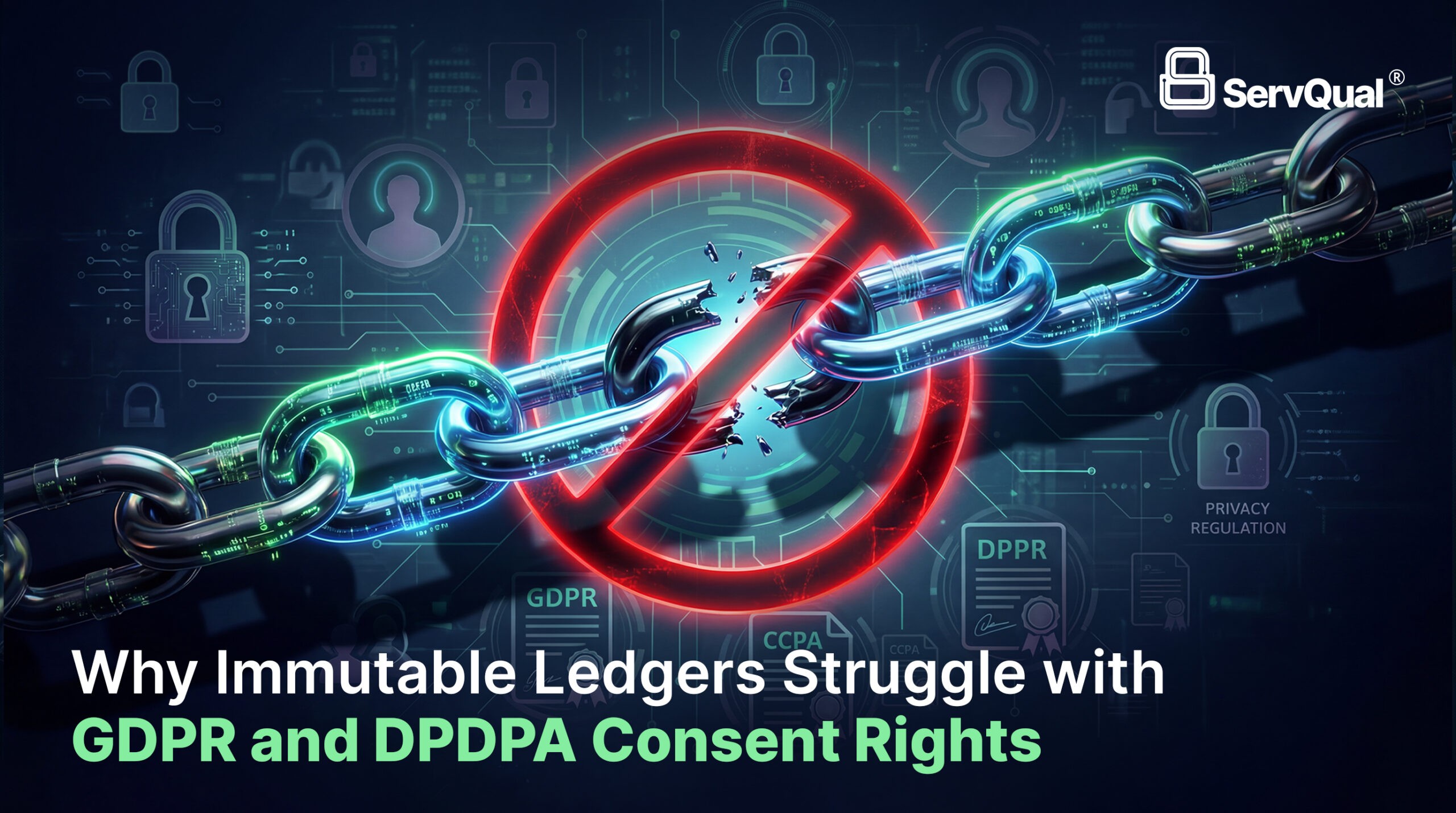
Immutable ledgers and blockchain systems are designed to preserve records, prove integrity and prevent unauthorized changes. This makes them valuable for audit trails, digital identity, financial transactions, consent records and governance workflows. However, privacy laws such as GDPR and DPDPA create obligations around consent withdrawal, correction, deletion, data minimization and personal data lifecycle management. The challenge is simple: how can organizations respect privacy rights when the underlying technology is designed to keep records permanent?
Executive Summary
Immutable ledger technologies such as blockchain provide strong data integrity, auditability, traceability and tamper resistance. These characteristics make them valuable for digital identity management, compliance records, financial transactions, supply chain traceability and governance workflows.
However, privacy regulations such as GDPR and India’s DPDPA grant individuals rights related to consent withdrawal, data correction and personal data deletion. This creates a fundamental challenge for organizations that store personal information in systems designed to maintain permanent records.
Balancing auditability with privacy compliance has become an important consideration for enterprise security, data governance, architecture, legal and risk management teams.
Why Immutable Ledgers Create Privacy Challenges
Immutable ledgers are designed to prevent records from being modified, deleted or overwritten after they are written. This helps preserve trust, integrity and auditability.
Privacy regulations, however, require organizations to manage personal data throughout its lifecycle. This includes collection, processing, storage, retention, correction, deletion and consent withdrawal.
When personal data is stored directly on-chain, organizations may struggle to support:
- Consent withdrawal
- Personal data deletion
- Data correction
- Retention limitation
- Data minimization
- Right to be forgotten requests
- Privacy-by-design requirements
- Regulatory evidence and accountability
This creates tension between permanent record systems and privacy obligations.
Privacy and Consent Management Challenge
Privacy regulations require organizations to give individuals greater control over their personal data.
At the same time, immutable ledger technologies are designed to preserve historical records and prevent tampering.
When personal data is written directly to a blockchain or immutable ledger, organizations may face difficulty in:
- Managing consent withdrawal requests
- Supporting data correction requirements
- Responding to data deletion requests
- Maintaining data minimization practices
- Demonstrating privacy-by-design controls
- Managing retention and deletion procedures
- Proving accountability to regulators and auditors
This creates a potential conflict between technical architecture and regulatory obligations.
Business and Compliance Significance
Organizations use blockchain and distributed ledger technologies to improve transparency, trust and auditability across business operations.
Common use cases include:
- Digital identity management
- Financial transaction records
- Supply chain traceability
- Consent management systems
- Regulatory audit logging
- Contract and workflow verification
- Governance and evidence records
While immutable ledgers strengthen accountability, privacy requirements must be considered during system design. Failure to align ledger architecture with privacy obligations can create compliance risks, governance challenges and increased regulatory scrutiny.
Technical Analysis: Immutable Ledgers vs Data Subject Rights
The core challenge comes from the different objectives of blockchain architecture and privacy regulations.
Immutable ledgers are designed to preserve historical records and ensure data integrity. Once information is written to the ledger, it is intended to remain available for verification and auditing.
Privacy regulations such as GDPR and DPDPA require organizations to support data subject rights, consent management and personal data lifecycle controls.
This creates important design questions:
- Should personal data ever be stored directly on-chain?
- Can a consent record be revoked if the original transaction is permanent?
- How can data correction be supported if ledger entries cannot be changed?
- How can deletion requests be handled when the record is immutable?
- How can organizations prove compliance without exposing personal data?
These questions should be addressed before blockchain or immutable ledger systems are implemented.
Hybrid Architecture: Off-Chain Personal Data and On-Chain Proof
A common approach is to avoid storing personal data directly on-chain.
Instead, organizations can use a hybrid architecture:
- Personal data is stored in secure off-chain repositories
- The blockchain stores cryptographic hashes, references or proofs
- Sensitive information remains subject to governance controls
- Data deletion and retention can be managed off-chain
- Ledger integrity is preserved without exposing personal data
- Auditability is maintained through verifiable references
This approach supports both auditability and regulatory compliance.
The blockchain can prove that an event occurred, while the personal data itself remains governed in a secure, manageable environment.
GDPR and DPDPA Compliance Implications
Organizations implementing immutable ledger technologies should evaluate their impact on privacy and compliance programs.
Key compliance considerations include:
- Consent withdrawal management
- Personal data correction processes
- Data deletion and retention requirements
- Data minimization obligations
- Privacy-by-design implementation
- Governance and accountability controls
- Audit trail and evidence management
- Cross-border data transfer considerations
- Vendor and third-party risk management
- Security and privacy impact assessments
Organizations that fail to address these considerations may encounter compliance gaps, legal exposure and increased regulatory scrutiny.
Real-World Consent Management Use Case
A financial services organization uses blockchain technology to record customer consent for digital services.
A customer later withdraws consent under applicable privacy regulations.
The organization can prevent future processing activities. However, the original consent transaction remains permanently recorded on the blockchain.
To reduce compliance risk, the organization stores personal information in a secure off-chain environment while maintaining only a cryptographic reference to the consent transaction on the ledger.
This preserves auditability while supporting privacy governance requirements.
Privacy and Governance Implementation Checklist
Before implementing blockchain or immutable ledger technology:
- Avoid storing personal data directly on-chain
- Establish clear consent management processes
- Use secure off-chain storage for sensitive information
- Conduct Privacy Impact Assessments or Data Protection Impact Assessments
- Apply data minimization principles
- Define retention and deletion procedures
- Implement privacy-by-design controls
- Maintain governance and audit documentation
- Review GDPR and DPDPA obligations
- Map personal data flows before deployment
- Define control ownership
- Maintain audit evidence
- Review vendor and third-party dependencies
- Validate whether immutable records create privacy risk
- Include legal, security, privacy and architecture teams in design reviews
How ServQual and SUSAN Support Privacy Compliance
ServQual and SUSAN help organizations align emerging technologies with privacy, governance and compliance requirements.
SUSAN supports privacy and GRC visibility by helping organizations connect risks, controls, assessments, evidence and compliance obligations into a structured governance view.
Key capabilities include:
- Privacy and compliance assessments
- GDPR and DPDPA readiness initiatives
- Privacy-by-design guidance
- Governance and risk management support
- Audit-ready reporting and evidence tracking
- Regulatory compliance monitoring
- Data governance program alignment
- Risk ownership tracking
- Policy and control management
- Continuous compliance visibility
These capabilities help organizations balance innovation, transparency, security and regulatory obligations.
"Blockchain secures the past. Privacy laws govern the present."

Purva Jadhav
Product Manager | ServQual
FAQ
Most frequent questions and answers
Yes. Compliance depends on the system architecture, governance controls and how personal data is managed throughout its lifecycle. Organizations should avoid storing personal data directly on-chain unless privacy obligations have been fully assessed.
Organizations should carefully evaluate privacy obligations before storing personal data on-chain. Secure off-chain storage is often used to support data deletion, correction, retention and consent management requirements.
Consent management is challenging because immutable ledgers are designed to preserve records permanently, while privacy laws may require organizations to support consent withdrawal, correction or deletion requests.
A common approach is to store personal data off-chain while maintaining cryptographic hashes, references or proofs on the blockchain. This preserves auditability while keeping personal data subject to governance controls.
The right to be forgotten creates a challenge because blockchain records are designed to be permanent. If personal data is stored directly on-chain, deletion may be difficult or impossible without affecting ledger integrity.
Organizations can reduce blockchain privacy risk by using off-chain storage, data minimization, privacy-by-design controls, consent management workflows, retention policies, DPIAs, governance reviews and audit evidence.
SUSAN helps organizations manage privacy, risk, compliance, evidence and governance activities so blockchain and immutable ledger use cases can be assessed against GDPR, DPDPA and broader data protection requirements.
As organizations adopt blockchain and immutable ledger technologies, balancing auditability with privacy compliance is becoming increasingly important.
Understanding how GDPR and DPDPA requirements apply to consent management, data governance and personal data lifecycle controls can help reduce compliance risk and strengthen trust.
Explore SUSAN, ServQual’s AI driven cybersecurity, privacy and GRC platform, or contact ServQual to discuss how your organization can assess privacy risk, implement Privacy by Design practices and support GDPR and DPDPA compliance across evolving digital ecosystems.