Executive Overview
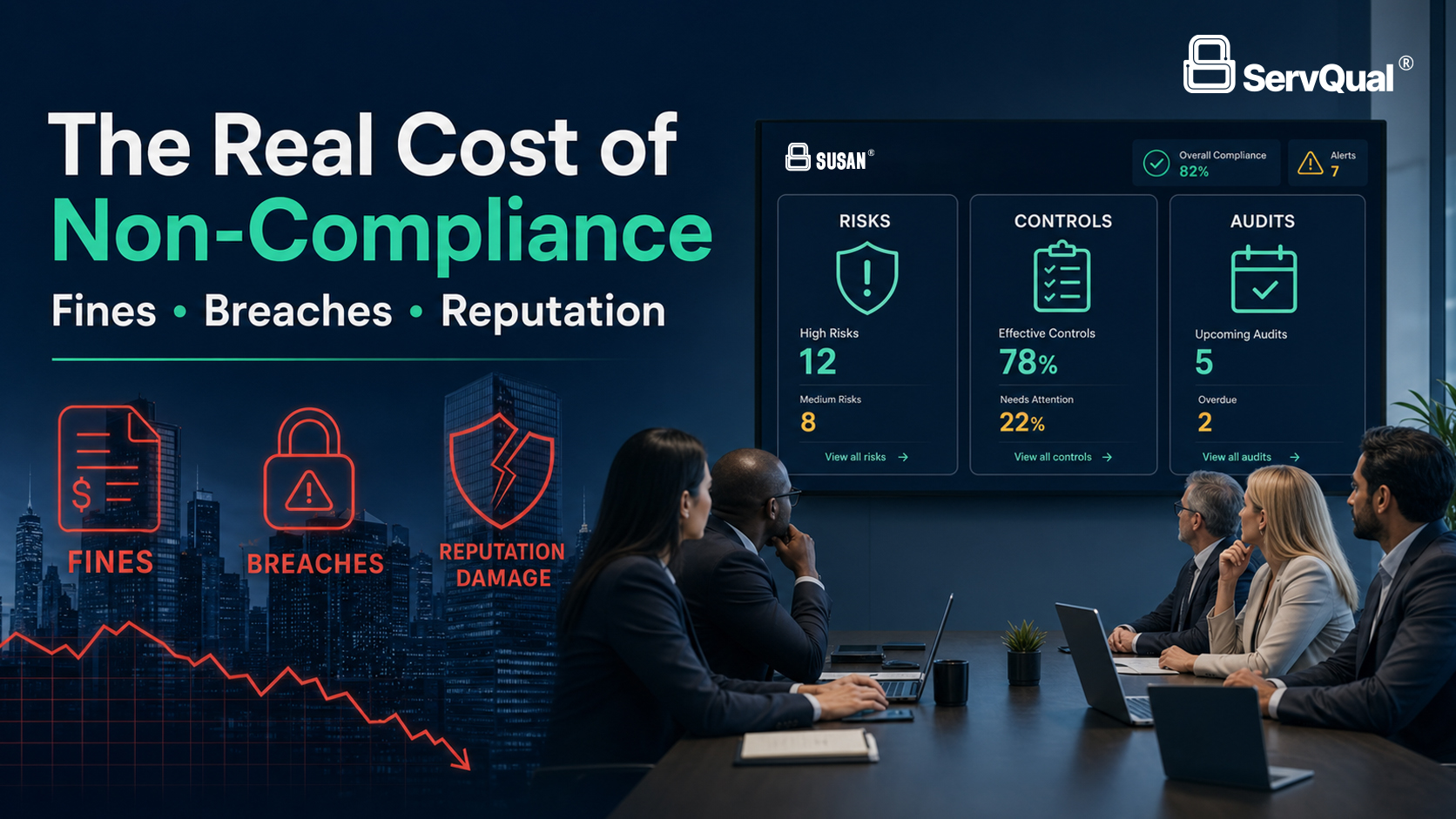
Non-compliance is not only a regulatory issue. It is a cybersecurity, governance, risk management and business resilience issue. When organizations fail to maintain effective compliance controls, they increase their exposure to regulatory fines, security incidents, data breaches, legal action, operational disruption and reputational damage.
As organizations process sensitive data across cloud platforms, SaaS tools, third-party ecosystems and AI enabled workflows, compliance has become closely connected to cybersecurity and operational resilience. Weak governance, poor evidence management, inconsistent data protection practices and delayed risk remediation can turn compliance gaps into business-impacting incidents.
The real cost of non-compliance can include regulatory penalties, breach response costs, legal expenses, remediation effort, customer trust erosion, audit pressure and long-term damage to brand reputation.
The Hidden Cost of Non-Compliance
Many organizations treat compliance as something required only during audits, regulatory reviews or certification assessments. This creates a dangerous gap between documented policies and actual operational practice.
Non-compliance can create broader business risks, including:
- Security incidents
- Data breaches
- Regulatory investigations
- Legal disputes
- Customer trust erosion
- Operational disruption
- Audit findings
- Vendor and customer concerns
- Increased remediation workload
When governance processes are weak and compliance controls are not consistently followed, organizations may unknowingly increase exposure to cyber threats, privacy risks and operational failures.
Non-compliance is therefore not just a paperwork issue. It is a sign that governance, risk ownership, control monitoring or evidence management may not be working effectively.
Why Compliance Matters Beyond Regulations
Modern compliance frameworks are designed to strengthen governance, accountability, risk management, security controls and operational resilience.
Frameworks such as ISO 27001, SOC 2, GDPR, DPDPA and NIST Cybersecurity Framework help organizations define how information security, privacy, incident response, risk management and control assurance should operate.
These frameworks support important business functions such as:
- Risk assessment
- Security governance
- Data protection
- Incident response
- Audit readiness
- Access control
- Third-party risk oversight
- Evidence management
- Business resilience
When these controls are ignored, poorly implemented or not reviewed regularly, the likelihood of security incidents and compliance failures increases.
A mature compliance program helps organizations prove that controls are not only documented but also operating in practice.
Understanding the Real Impact of Non-Compliance
The impact of non-compliance can appear in many forms. Some are immediate, such as regulatory fines or incident response costs. Others are long-term, such as reputational damage, customer loss and increased scrutiny from regulators or partners.
Financial Impact
Non-compliance can result in:
- Regulatory penalties
- Legal expenses
- Settlement costs
- Incident response expenses
- Recovery and remediation costs
- Increased audit and consulting effort
- Higher insurance or contractual risk
- Loss of business opportunities
The cost of non-compliance often exceeds the cost of maintaining structured compliance programs because incidents can create regulatory, legal, operational, remediation and reputational expenses.
Security Impact
Weak compliance practices can directly affect cybersecurity posture.
Common security impacts include:
- Data breaches
- Unauthorized access
- Misconfigured systems
- Sensitive data exposure
- Insider risk
- Weak monitoring
- Delayed remediation
- Poor incident response readiness
Compliance failures often reduce visibility into whether security controls are working as intended. If access reviews, risk exceptions, evidence checks, third-party assessments and data handling controls are not maintained, security teams may not see risk until an incident occurs.
Operational Impact
Non-compliance can also affect day-to-day operations.
Organizations may experience:
- Business disruption
- Delayed projects
- Increased audit workload
- Regulatory response pressure
- Customer and vendor concerns
- Increased manual evidence collection
- Reduced operational resilience
When compliance is managed manually or only during audit cycles, teams often spend more time collecting evidence than improving controls.
Reputational Impact
Reputational damage can continue long after the original compliance issue has been remediated. Customers, regulators, investors, partners and employees may lose confidence if an organization cannot demonstrate responsible governance and data protection.
Reputational impact can affect:
- Customer confidence
- Brand trust
- Business relationships
- Investor confidence
- Vendor relationships
- Market perception
For regulated or data-intensive organizations, trust is a business asset. Non-compliance can weaken that trust quickly.
When Compliance Failures Become Security Incidents
A growing organization may have compliance documentation, security policies and control procedures, but still fail operationally if those controls are not actively maintained.
Common warning signs include:
- Risk exceptions are not documented
- Security reviews are delayed
- Third-party risks are not monitored continuously
- Sensitive data handling is inconsistent
- Access reviews are incomplete
- Audit evidence is collected manually at the last minute
- Control owners are unclear
- Incident response procedures are not tested
Over time, these weaknesses can contribute to a data exposure incident, regulatory review or internal investigation.
This shows why compliance cannot be treated as a one-time audit activity. It must be part of continuous governance, security monitoring and operational accountability.
Regulatory and Compliance Implications
Non-compliance can lead to regulatory investigations, audit findings, breach notification obligations, legal consequences and increased scrutiny from regulators.
Organizations should treat compliance as an ongoing governance responsibility rather than a periodic audit exercise.
Important areas to maintain include:
- Policy governance
- Data protection controls
- Access control reviews
- Vendor risk management
- Incident response readiness
- Evidence tracking
- Control ownership
- Regulatory obligation tracking
- Privacy and data protection workflows
- Continuous monitoring
Strong compliance governance helps organizations identify issues earlier, assign ownership and reduce the chance that small control gaps become major security or regulatory incidents.
Compliance and Risk Management Essentials
Organizations can reduce non-compliance risk by building a repeatable governance model.
Key essentials include:
- Governance accountability
- Continuous monitoring
- Risk ownership
- Audit evidence management
- Security awareness
- Third-party risk oversight
- Incident response readiness
- Regulatory compliance tracking
- Operational resilience
- Clear control ownership
- Regular compliance reviews
- Documented remediation plans
A strong Governance, Risk, Compliance and Audits approach helps organizations connect policies, controls, risks, evidence and business accountability.
Cybersecurity Services, Privacy by Design practices and continuous compliance workflows can also help organizations reduce exposure to regulatory, operational and security risks.
How SUSAN Strengthens Compliance Governance
SUSAN is ServQual’s AI driven cybersecurity, privacy and GRC platform that helps organizations improve risk visibility, evidence tracking, audit readiness and continuous compliance.
SUSAN helps organizations centralize governance, risk, compliance and operational accountability through a structured GRC approach.
Key capabilities include:
- Compliance monitoring
- Risk management
- Audit evidence tracking
- Governance visibility
- Policy management
- Risk ownership tracking
- Multi-framework compliance mapping
- Continuous compliance assessment
- Evidence visibility
- Control gap tracking
- Audit readiness support
By connecting compliance activities with operational workflows, SUSAN helps organizations identify governance gaps before they become audit findings, security incidents or regulatory issues.
SUSAN can help security, privacy, compliance and leadership teams move from point-in-time compliance checks to continuous assurance.
Practical Non-Compliance Risk Checklist
Use this checklist to assess whether your organization may be exposed to non-compliance risk:
- Are compliance responsibilities clearly assigned?
- Are control owners documented?
- Are risk exceptions reviewed and approved?
- Are access reviews performed regularly?
- Is audit evidence collected continuously?
- Are third-party risks monitored?
- Are privacy and data protection requirements tracked?
- Are incident response procedures tested?
- Are regulatory obligations mapped to controls?
- Are remediation actions tracked to closure?
- Are security and compliance teams working from the same risk view?
- Is leadership able to see compliance and cybersecurity risk together?
If the answer is no to several of these questions, the organization may have compliance visibility gaps that need review.
"Non compliance is rarely one big mistake, it’s many small risks left unchecked"

Purva Jadhav
Product Manager | ServQual
FAQ
Most frequent questions and answers
The cost of non-compliance can include regulatory fines, legal expenses, breach response, operational disruption, audit workload, remediation costs and reputational damage.
Yes. Weak governance and compliance failures can contribute to data breaches, unauthorized access, delayed remediation, sensitive data exposure and operational vulnerabilities.
Compliance frameworks help organizations establish governance, accountability, risk management, security controls, incident response practices and data protection processes that support operational resilience.
Organizations can reduce the cost of non-compliance by maintaining governance accountability, continuous monitoring, risk ownership, audit evidence, third-party risk oversight, incident response readiness and regulatory compliance tracking.
Non-compliance can weaken cybersecurity by reducing control visibility, delaying risk remediation, increasing exposure to unauthorized access and creating gaps in data protection, monitoring and incident response.
SUSAN helps organizations centralize risk, compliance, evidence and governance visibility so teams can identify gaps, track ownership and improve audit readiness.
Audit evidence helps organizations prove that policies, controls, risk reviews, security activities and compliance obligations are being maintained in practice, not only documented.
Want to strengthen compliance visibility, governance accountability and operational resilience?
Explore SUSAN, ServQual’s AI driven cybersecurity, privacy and GRC platform, or contact ServQual to discuss how your organization can improve audit readiness, evidence visibility and compliance governance.
ServQual supports cybersecurity, privacy and GRC requirements across multiple regions through its global operating presence.