Organizations share documents every day with customers, regulators, auditors, suppliers, legal teams and business partners. These documents may contain personal data, investigation notes, financial records, contracts, access details, legal strategy or confidential business information.
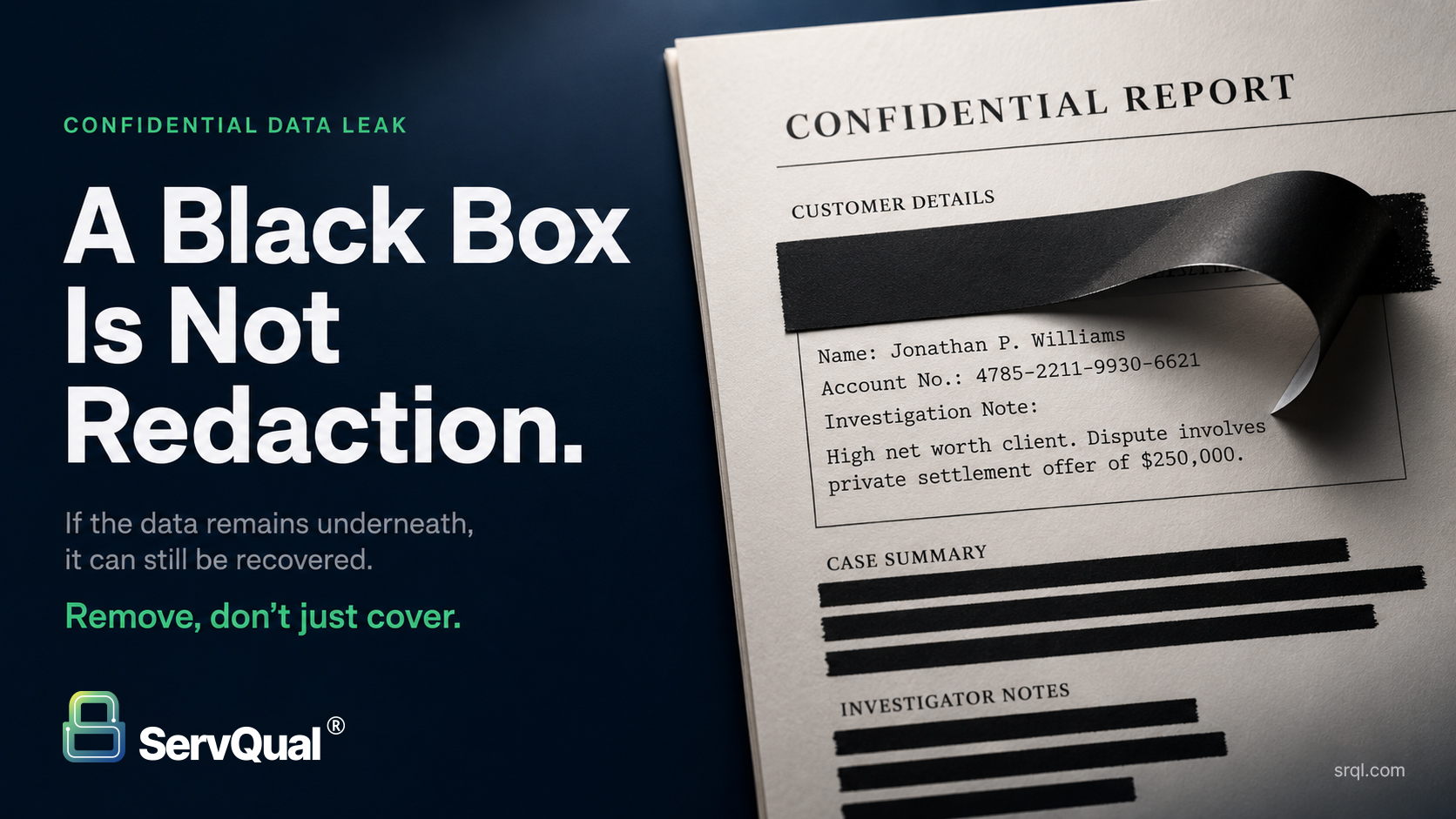
When redaction is performed visually but not technically, sensitive data may remain inside the file. A black box placed over text is not the same as secure redaction. If the underlying content can still be selected, searched, copied or extracted, the information was never truly removed.
The Hidden Challenge in Document Redaction
Redaction appears simple.
Identify sensitive information. Cover it. Export the document. Share it.
The problem is that many users mistake visual masking for true redaction. Basic PDF editing tools may place a black rectangle over text while leaving the original content underneath fully intact.
This means the document can appear protected, while names, account numbers, personal information, investigation notes, legal details, or confidential business data remain accessible.
True redaction permanently removes sensitive content from the document. Visual masking only hides it from view.
Why Redaction Failures Matter
A redaction failure is not only a formatting error. It is a data exposure event.
Unlike a traditional cyberattack, the organization often creates the exposure itself by sharing a document that still contains recoverable confidential information.
The consequences can include:
- Exposure of personal information
- Disclosure of confidential business data
- Leakage of investigation records
- Regulatory non-compliance
- Privacy violations
- Loss of stakeholder trust
- Reputational damage
- Increased audit scrutiny
In highly regulated industries such as financial services, healthcare, legal services, and government, improper redaction can have serious compliance implications.
Why Redaction Failures Create Enterprise Risk
Redaction failures create risk because organizations often believe sensitive information has been removed when it is still present in the document structure.
Common risks include:
- Sensitive data leakage
- Unauthorized access to personal data
- Exposure of confidential business information
- Legal and regulatory disclosure risk
- Weak secure document sharing controls
- Loss of customer and partner trust
- Increased audit findings
- Compliance evidence gaps
- Privacy breach investigation workload
- Reputational damage
For regulated organizations, redaction failure can affect privacy compliance, legal privilege, audit readiness, incident response and governance accountability.
How Sensitive Data Still Leaks After Redaction
Sensitive data can remain exposed when redaction is done incorrectly.
Common causes include:
- Drawing black rectangles over text instead of removing the text layer
- Exporting files without flattening or sanitizing hidden content
- Leaving metadata, comments or revision history inside the document
- Failing to remove embedded objects, annotations or attachments
- Sharing editable documents instead of sanitized final files
- Using screenshot-based workarounds without validation
- Not testing the final document with copy-paste, search or extraction checks
A document should not be considered safely redacted until the sensitive content is technically removed and validated.
How Redaction Failures Occur
Improper redaction commonly happens when users:
- Draw black boxes or shapes over text
- Use screenshot-based masking
- Apply visual overlays without removing the underlying content
- Share documents without validation
- Fail to review exported files before release
- Ignore metadata and hidden document layers
- Rely on manual habits instead of controlled procedures
The result is a document that looks secure but still contains recoverable sensitive information.
Organizations should treat redaction as a controlled data protection process, not a last-minute editing task.
When Compliance Looks Strong but Data Still Leaks
Consider a financial services company preparing a report for an external partner.
The report contains information relating to multiple customers, including names, account numbers, and investigation notes.
The requirement is clear:
- Share only Person A’s information
- Completely remove all information relating to Person B and Person C
An analyst opens the PDF and uses a basic editing tool to place black rectangles over the sections containing Person B and Person C’s information.
After a quick visual review, the document appears properly redacted and is shared externally.
A few days later, the partner’s security team performs a simple validation.
They select all text inside the document and copy it into a text editor.
The result is alarming.
Names, account numbers, and investigation notes relating to Person B and Person C appear in full.
The information was never removed. It was only visually hidden.
Regulatory and Compliance Impact
Improper redaction can create exposure under privacy, confidentiality, and information security requirements.
This can affect obligations linked to GDPR, DPDPA, ISO 27001, internal security policies, contractual confidentiality requirements, and audit evidence management.
Regulators and auditors may treat redaction failures as unauthorized disclosure of sensitive information rather than a simple technical mistake.
Organizations may face:
- Compliance findings
- Regulatory investigations
- Legal consequences
- Contractual issues
- Customer complaints
- Increased audit scrutiny
- Evidence handling concerns
For privacy and security teams, redaction must be part of governance, not just document editing.
Redaction Risk Management Essentials
Organizations should establish a formal redaction governance process that includes:
- Documented redaction procedures
- Approved redaction tools
- Validation and quality assurance checks
- Review and approval workflows
- Secure document handling practices
- Staff awareness and training
- Evidence of review before external release
- Clear accountability for document disclosure
- Governance oversight for high-risk documents
High-risk documents should not be released based only on visual inspection. Teams should verify that sensitive data has been permanently removed.
Privacy, Compliance and Governance Impact
Redaction failures can create privacy and compliance exposure when personal data, confidential records or regulated information is shared externally.
Relevant risk areas include:
- GDPR and DPDP compliance
- Data protection obligations
- Secure document sharing
- Confidential data handling
- Audit trail and approval evidence
- Legal disclosure controls
- Third-party risk management
- Incident response and breach assessment
- Data classification and retention controls
Organizations should treat redaction as part of information governance, not only as a document formatting task. Secure redaction requires policy, ownership, technical validation, evidence collection and review before documents are released.
How SUSAN Helps Strengthen Redaction Governance
SUSAN by ServQual helps organizations connect redaction risk with governance, risk, compliance and evidence management.
Organizations can use SUSAN to support:
- Document handling policies
- Redaction risk tracking
- Approval workflows
- Audit evidence management
- Privacy and compliance oversight
- Control ownership
- Issue and remediation tracking
- Compliance evidence collection
- Governance visibility for leadership
SUSAN helps make redaction part of structured GRC rather than a last-minute manual step. Instead of relying on scattered tools, emails and individual habits, teams can maintain a clearer record of responsibilities, approvals and evidence related to sensitive document handling.
Learn more about SUSAN here: https://srql.com/services/susan/
Key Takeaway
If sensitive data can still be recovered, it was never truly protected.
Black boxes are not redaction. Visual masking is not data removal. A document that looks safe may still expose personal, legal, financial, or confidential information.
Organizations need redaction procedures, validation checks, audit evidence, and clear accountability before sensitive documents are released externally.
Do not wait for an audit, regulator, customer, or external partner to discover the gap.
"If sensitive data can still be recovered, it was never truly protected."

Vaishnavi Pawar
Security Researcher | ServQual
FAQ
Most frequent questions and answers
Redaction failure occurs when sensitive information appears hidden or blacked out in a document but remains recoverable through copy-paste, search, metadata, hidden layers, OCR or extraction tools.
PDF redaction failures often happen when users visually cover text with black boxes instead of permanently removing the underlying text, metadata, annotations or embedded content.
Poor redaction can expose personal data, account numbers, investigation notes, financial records, legal strategy, customer information, contracts, access details and confidential business information.
Redaction failure can become a data breach or disclosure incident if personal data, regulated information or confidential content is shared with unauthorized parties.
Organizations can prevent redaction failures by using proper redaction tools, removing hidden content, validating final files, applying approval workflows, maintaining audit evidence and training teams on secure document sharing.
Redaction supports GDPR and DPDP compliance by reducing the risk of unauthorized disclosure of personal data and helping organizations apply data minimization, privacy protection and secure processing controls.
SUSAN helps organizations track redaction-related risks, approvals, evidence, controls and governance activities so sensitive document handling becomes part of structured privacy, security and GRC oversight.
Want to improve document governance, privacy compliance, and redaction accountability?
Discover how SUSAN helps organizations manage document protection, governance workflows, audit evidence, and compliance activities through a centralized GRC platform.